-
Originally posted by Jewpinthethird -
Re: Oops I broke the laws of math.
Yes and no. Yes, there are different "sizes" of infinity. The size of an infinite group is called its cardinality.
But those two ensembles have the same cardinality: aleph-null. You can see that by pairing each term. 1st term with 1st term, etc. You won't be able to find a number in one ensemble that doesn't have a pairing. If you want a larger infinity, you have to look in non-countable ensembles. Real numbers, for example. There are infinitely more real numbers than there are integers.Comment
-
Re: Oops I broke the laws of math.
Don't know if this has been posted yet, but:
0.999999999999etc.=1
x=0.99999
Therefore 10x=9.99999
10x-x=9.99999-0.99999=
9x=9
9x/9=9/9
x=1
o0o0o0o0oComment
-
Re: Oops I broke the laws of math.
yes, except this one is actually true
it's already been proven through many proofs that 0.9... = 1
another one could be 1/3 = 0.3..., 2/3 = 0.6..., then 3/3 = 0.9..., or 1
also 1/9 = 0.1..., 2/9 = 0.2..., 5/9 = 0.5..., etc. And if you look, 9/9 should equal 0.9... according to that pattern but it's also 1; you could also say 8/9 (0.8...) + 1/9 (0.1...) = 0.9..., or 1.Originally posted by Djr Rap dancerComment
-
Re: Oops I broke the laws of math.
you could also say 2/9 + 7/9 = 1
you could also say 4/9 + 5/9 = 1
can we not point out obvious solutions thanks(´・ω・`)Comment
-
Re: Oops I broke the laws of math.
Proof 6 = Vote4Nixon
I AM ASHAMED OF MY STUPIDITY AND MUST COMMIT SEPPUKU. FORGIVE ME, FFR.

Ninjas NEVER die. Now on a 30 kill streak.Comment
-
Re: Oops I broke the laws of math.
Building on emerald's logic, let me pose to you all a question.
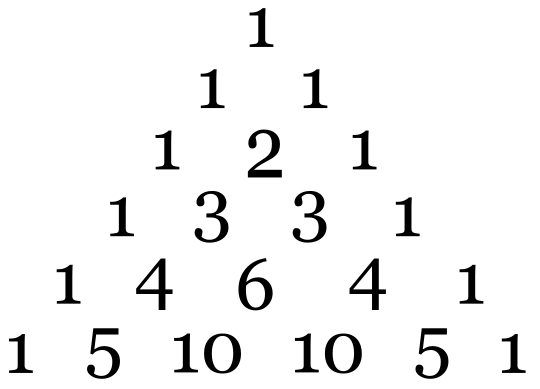
Consider Pascal's Triangle (each number is the sum of the two numbers above it):
I shall make the claim that given a Pascal's Triangle that is infinitely large, I can throw a dart at this triangle -- at ANY spot -- and have a 0 percent change of hitting an odd number. Not "roughly zero" -- EXACTLY zero. Not "it's very unlikely," but rather "literally impossible."
Mathematical truth, or is Rubix trying to pull a fast one on you all?Comment
-
Re: Oops I broke the laws of math.
I threw one and it missed the triangleComment
-
Re: Oops I broke the laws of math.
i'd like to see how the hell you would prove it. but i am curious All public 1-7's AAA'd.
15 8's left to AAA
Average Rank: 152
Originally posted by duddychuck@yahoo.comComment
-
Comment
-
Re: Oops I broke the laws of math.
That has to be about combinatorics, but I can't see how you would do that. Heck, I still have to see that's the right answer.
EDIT: Just saw a beautiful pattern. I see now that it has a zero chance of getting an odd number. Now to prove it...Comment
-
Re: Oops I broke the laws of math.
Yay, zero percentage of getting an odd number.
I AM ASHAMED OF MY STUPIDITY AND MUST COMMIT SEPPUKU. FORGIVE ME, FFR.
Ninjas NEVER die. Now on a 30 kill streak.Comment
-
Re: Oops I broke the laws of math.
30-second logic:
In a practical sense, because there are odd numbers in the triangle, even an infinitely large one, there will always be points which the dart can hit which will be odd numbers. Specifically the first and last numbers of each row.
In a strictly mathematical probability sense, as the size of the triangle increases, the ratio of evens : odds rises (note: I'm not entirely sure of this, actually). So as the size of the triangle approaches infinity, the probability of any arbitrary number on the triangle being odd approaches zero.
disclaimer no this probably isn't the correct reasoning blah blah blah it's just a result of quick look
edit: I should get my discrete math professor to look at this (John Mackey, best math teacher I've ever had)Comment
-
Re: Oops I broke the laws of math.
i get it now... but the way you prove it through philosophy is BS >.>
edit:
ninja'd... I was not referring to above posters logic.All public 1-7's AAA'd.
15 8's left to AAA
Average Rank: 152
Originally posted by duddychuck@yahoo.comComment
-
Re: Oops I broke the laws of math.
Well, I guess it could simply be proven by saying that the numbers modulo 2 makes a wonderful Sierpinski triangle (slightly cut off if the number of rows isn't a power of 2). The odd numbers are the plotted points. So since the area of the Sierpinski triangle after an infinity of iterations is null, (each iteration removes 1/4 of the remaining area-> converges towards zero) the probability of getting an odd number is null.
EDIT: Relambrian, the hard part is actually proving the ratio even dd is bigger than one.
EDIT2: After rereading, I see it is not really clear, but I understand myself and that's what is important. Right... Right?Last edited by emerald000; 10-19-2009, 11:21 PM.Comment




 That takes some srs skill

Comment