|
|
#11 |
|
⊙▃⊙
|
What's in the sky tonight?
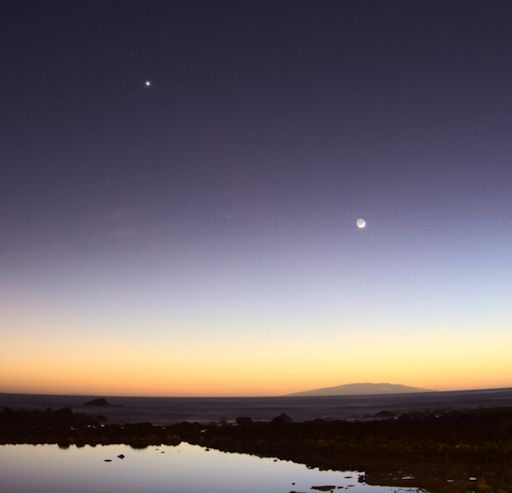
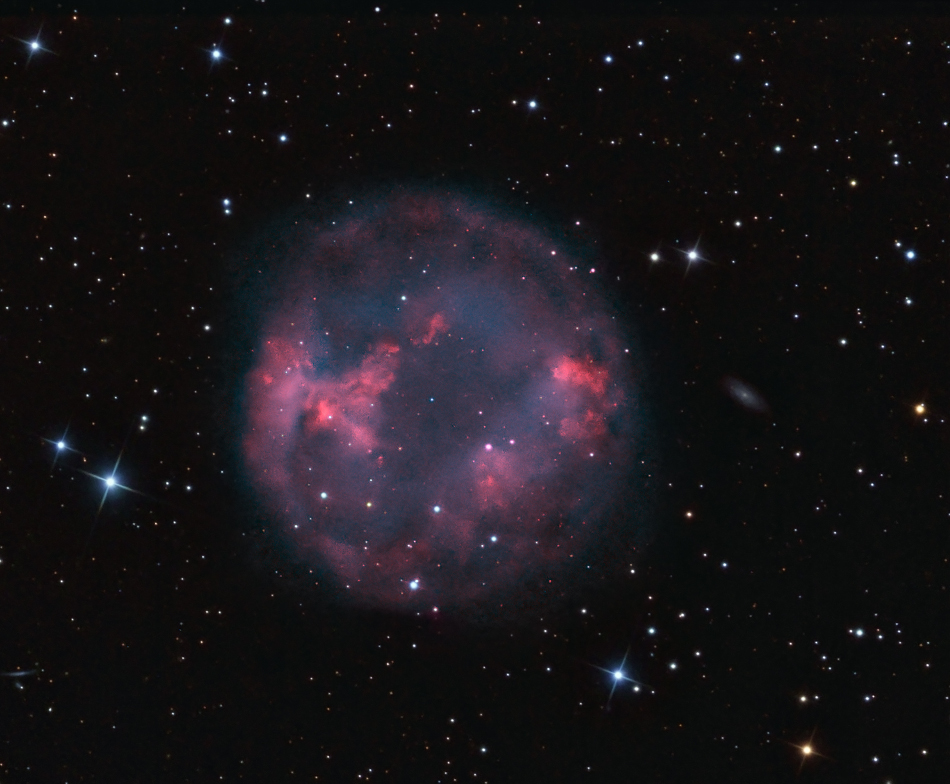
December 5, 2013 -The crescent Moon poses about 7° to Venus's upper right in twilight, as shown here. As the sky darkens, look with binoculars for Alpha and Beta Capricorni to the Moon's upper left. Both are double stars for binoculars: Alpha is very easy to resolve, Beta is harder. -When the sun goes down tonight, step outside and look southwest. The crescent Moon and Venus are converging for a beautiful close encounter. These are the two brightest objects in the night sky and they pop out of the twilight long before the sky fades to black. Erwin Matys and Karoline Mrazek of Project Nightflight photographed the pair converging over the Canary island El Hierro on Dec. 4th. They'll be even closer together tonight. With less than 10o of arc seperating the two, they would fit together inside the bowl of the Big Dipper. If you have binoculars or a small telescope, take a closer look at the heavenly bodies. Both are crescents. Like the Moon, Venus has phases and tonight it is 27% illuminated. For comparison, the lunar crescent is half as wide, about 13.5%. Bonus: This week Venus is at its brightest for 2013, shining almost 200 times brighter than a 1st-magnitude star. That's why it is so easy to see before darkness falls. Look southwest as soon as the sun sets. ![]() ![]() Astro Picture of the Day: December 5, 2013 ![]() Very faint planetary nebula Abell 7 is some 1,800 light-years distant, just south of Orion in planet Earth's skies in the constellation Lepus, The Hare. Surrounded by Milky Way stars and near the line-of-sight to distant background galaxies, its generally simple spherical shape, about 8 light-years in diameter, is outlined in this deep telescopic image. Within its confines are beautiful, more complex details enhanced by the use of narrowband filters. Emission from hydrogen and nitrogen is shown in reddish hues with oxygen emission mapped to a bluish-green color, giving Abell 7 a more natural appearance that would otherwise be much too faint to be appreciated by eye. A planetary nebula represents a very brief final phase in stellar evolution that our own Sun will experience 5 billion years hence, as the nebula's central, once sun-like star shrugs off its outer layers. Abell 7 itself is estimated to be 20,000 years old. Its central star is seen here as a fading white dwarf some 10 billion years old.
__________________
1st in Kommisar's 2009 SM Tournament 1st in I Love You`s 2009 New Year`s Tournament 3rd in EnR's Mashfest '08 tournament 5th in Phynx's Unofficial FFR Tournament 9th in D3 of the 2008-2009 4th Official FFR Tournament 10th in D5 of the 2010 5th Official FFR Tournament 10th in D6 of the 2011-2012 6th Official FFR Tournament FMO AAA Count: 71 FGO AAA Count: 10 Bluearrowll = The Canadian player who can not detect awkward patterns. If it's awkward for most people, it's normal for Terry. If the file is difficult but super straight forward, he has issues. If he's AAAing a FGO but then heard that his favorite Hockey team was losing by a point, Hockey > FFR PS: Cool AAA's Terry - I Love You An Alarm Clock's Haiku beep beep beep beep beep beep beep beep beep beep beep beep beep beep beep beep beep - ieatyourlvllol |
|
|
|
| Currently Active Users Viewing This Thread: 1 (0 members and 1 guests) | |
|
|