Go Back   Flash Flash Revolution > General Discussion > Chit Chat
Register FAQ Community Calendar Today's Posts Search


Thread Tools Display Modes
Prev Previous Post   Next Post Next
Old 03-26-2014, 06:28 AM   #11
Bluearrowll
⊙▃⊙
FFR Simfile AuthorD7 Elite KeysmasherFFR Veteran
 
Bluearrowll's Avatar
 
Join Date: Nov 2007
Location: I live in the last place where you Look.
Age: 33
Posts: 7,376
Send a message via AIM to Bluearrowll Send a message via MSN to Bluearrowll
Default Re: Terry's Astronomy Thread.

Daily Suspicious0bserver's Weather Post:
March 26, 2014


What's in the sky tonight?
March 26, 2014
-As dawn brightens on Thursday morning the 27th, you'll find Venus near the thin waning crescent Moon, as shown here.

-The waning Moon pairs with Venus on Thursday morning the 27th in the longitudes of the Americas. European observers: move each Moon symbol a quarter of the way toward the one for the previous date. In the Far East, move it halfway. The Moon here is drawn three times actual size.

-A CME hit Earth's magnetic field on March 25th at approximately 19:45 UT. The glancing blow was relatively weak, but auroras appeared anyway. Hours after the impact, green lights dueled with the blue glow of dawn over Sørkjosen, Norway." The sky was really bright at 3am, but I could still see the auroras," says photographer Tommy Richardsen. "Times around equinoxes really are special. You can see auroras even when you should not be able to."

He's right. For reasons researchers do not fully understand, equinoxes favour auroras. As northern spring unfolds, even relatively small gusts of solar wind and weak CME impacts can spark a good display. NOAA forecasters estimate a 40% chance of geomagnetic storms on March 26th as Earth passes through the wake of the CME.


News Posted Today:
March 25, 2014
Have We Spotted Dark Matter in the Milky Way?


Astro Picture of the Day:
March 26, 2014

Source:
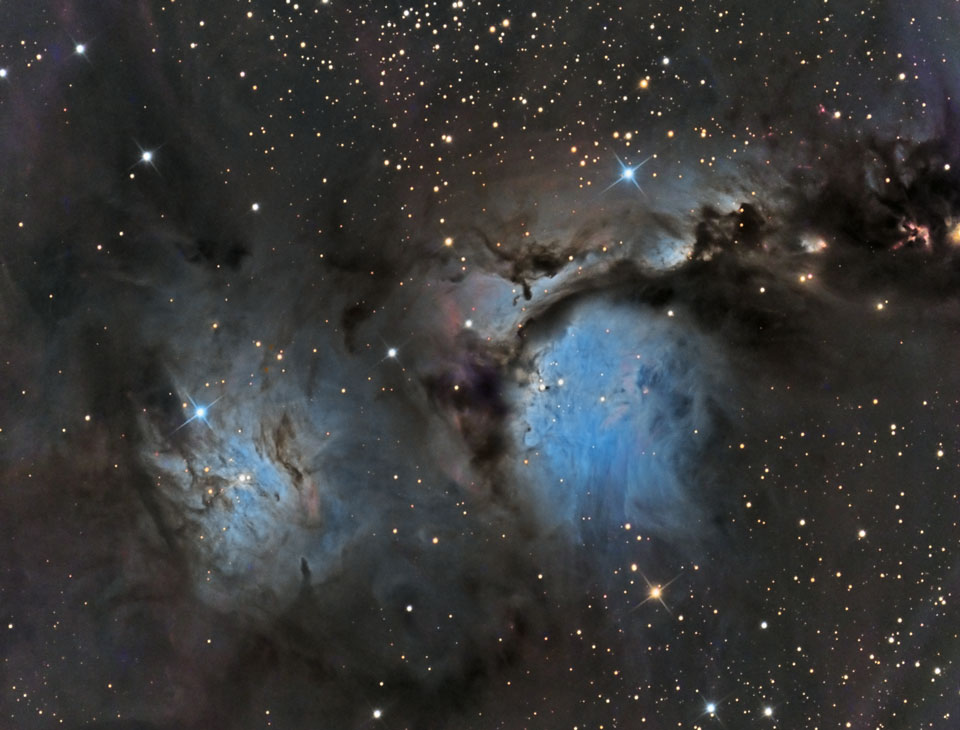
An eerie blue glow and ominous columns of dark dust highlight M78 and other bright reflection nebula in the constellation of Orion. The dark filamentary dust not only absorbs light, but also reflects the light of several bright blue stars that formed recently in the nebula. Of the two reflection nebulas pictured above, the more famous nebula is M78, in the image center, while NGC 2071 can be seen to its lower left. The same type of scattering that colors the daytime sky further enhances the blue color. M78 is about five light-years across and visible through a small telescope. M78 appears above only as it was 1600 years ago, however, because that is how long it takes light to go from there to here. M78 belongs to the larger Orion Molecular Cloud Complex that contains the Great Nebula in Orion and the Horsehead Nebula.
__________________
1st in Kommisar's 2009 SM Tournament
1st in I Love You`s 2009 New Year`s Tournament
3rd in EnR's Mashfest '08 tournament
5th in Phynx's Unofficial FFR Tournament
9th in D3 of the 2008-2009 4th Official FFR Tournament
10th in D5 of the 2010 5th Official FFR Tournament
10th in D6 of the 2011-2012 6th Official FFR Tournament

FMO AAA Count: 71
FGO AAA Count: 10

Bluearrowll = The Canadian player who can not detect awkward patterns. If it's awkward for most people, it's normal for Terry. If the file is difficult but super straight forward, he has issues. If he's AAAing a FGO but then heard that his favorite Hockey team was losing by a point, Hockey > FFR
PS: Cool AAA's Terry
- I Love You


An Alarm Clock's Haiku
beep beep beep beep beep
beep beep beep beep beep beep beep
beep beep beep beep beep
- ieatyourlvllol
Bluearrowll is offline   Reply With Quote


Currently Active Users Viewing This Thread: 1 (0 members and 1 guests)
 

Posting Rules
You may not post new threads
You may not post replies
You may not post attachments
You may not edit your posts

BB code is On
Smilies are On
[IMG] code is On
HTML code is Off

Forum Jump


All times are GMT -5. The time now is 10:42 PM.


Powered by vBulletin® Version 3.8.1
Copyright ©2000 - 2026, Jelsoft Enterprises Ltd.
Copyright FlashFlashRevolution