

http://events.slooh.com/ - next telecast for the asteroid will be at 9:00pm EST.
In this link, you should see a "streak" across the visible point in the webcast. That is the asteroid. There are many different views you can see, including a live "diagram" of it's path, and an actual picture of the asteroid.
A video of the passing can be found here:
A quick run down of what's happening can be found here. Essentially an asteroid that was discovered in 2005, the size of an aircraft carrier is passing earth at a point that is closer than the moon - it's closest point will be at 6:28pm EST.
It is an 11th magnitude object, which means that those who are in a city are probably not going to see the asteroid. It favours Western Europe and Eastern North America in terms of viewing for those who have a 12 inch telescope.
Diagram of path:

a couple screenshots of that telecast from about 30 minutes ago:
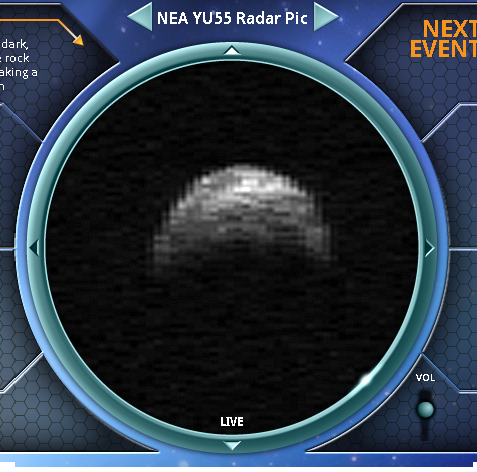
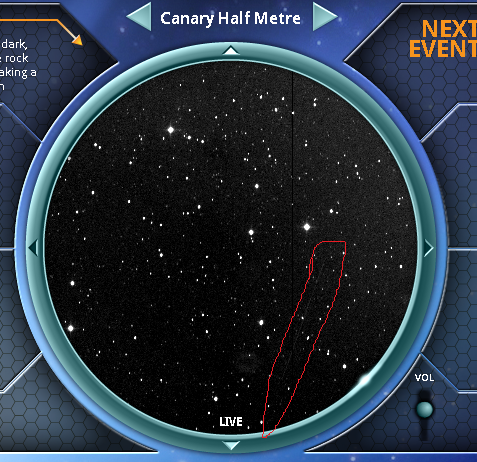
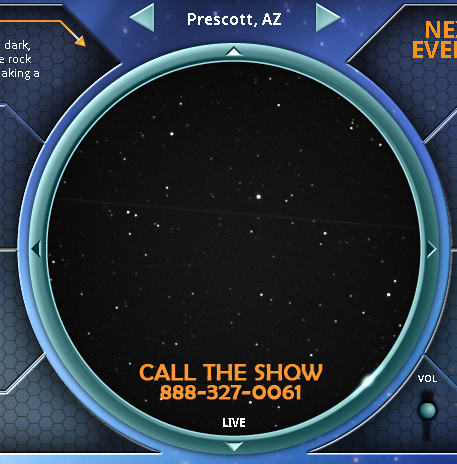
In this link, you should see a "streak" across the visible point in the webcast. That is the asteroid. There are many different views you can see, including a live "diagram" of it's path, and an actual picture of the asteroid.
A video of the passing can be found here:
A quick run down of what's happening can be found here. Essentially an asteroid that was discovered in 2005, the size of an aircraft carrier is passing earth at a point that is closer than the moon - it's closest point will be at 6:28pm EST.
It is an 11th magnitude object, which means that those who are in a city are probably not going to see the asteroid. It favours Western Europe and Eastern North America in terms of viewing for those who have a 12 inch telescope.
Diagram of path:
Roll out the red carpet! Earth is about to be visited by the largest close-approaching asteroid on record. Known as 2005 YU55, it comes closest to us on November 8th at 23:28 Universal Time (6:28 p.m. EST), when it passes 198,000 miles (319,000 km) from Earth's surface — closer than the Moon's orbit. It will be visible from the Americas and Europe through much of the night.
This radar image of asteroid 2005 YU55 was generated from radar data taken on November 7, 2011, using NASA's giant radio dishes in California. At the time the asteroid was 860,000 miles (1,380,000 km) from Earth. Radar illumination is from the top, so only half of the asteroid is apparent.
NASA / JPL
Discovered nearly six years ago by Robert McMillan at Steward Observatory's Spacewatch Telescope in Arizona, 2005 YU55 has been this way before. In April 2010 it passed close enough for detailed radar probing by the giant radio dish at Arecibo, Puerto Rico.
The Arecibo observations showed this asteroidal emissary to be a quarter mile (400 meters) across and remarkably round. Given its size and dimness, its surface must be quite dark and thus likely carbon-rich. Its rotation period is relatively long, 18 to 20 hours.
In the grand scheme of things it's more micro-planet than minor planet, but we've never knowingly had something this big come this close before. Were it to strike Earth, 2005 YU55 would deliver a kinetic-energy punch equivalent to several thousand megatons of TNT. It's the kind of potential threat that outer-space sentries lose sleep over.
This animation shows the trajectory of asteroid 2005 YU55 as it cruises past Earth on the night of November 8-9, 2011.
NASA / JPL
But fear not: the Arecibo observations allowed dynamicists to recompute the big rock's orbit with enough accuracy to ensure that it won't strike Earth within the next 100 years. (That said, it will pass just 175,000 miles from Venus in 2029, close enough to alter its orbit slightly. This adds uncertainty to predictions for its next close encounter with Earth in 2041, when the minimum distance could be anywhere from 200,000 to 30 million miles.)
So we might as well just enjoy this month's show. The asteroid will approach Earth from the sunward direction, so it will be a daylight object until just before the time of closest approach. A few hours later 2005 YU55 should reach a visual magnitude of 11.1, within reach of backyard telescopes with apertures of at least 6 inches under fairly dark skies — though you'll be fighting light from the nearly full Moon.
Best seen from North America, the little asteroid 2005 YU55 will race far across the constellations in just 11 hours. Click here for a more detailed chart and instructions.
Sky & Telescope illustration
The pass's track is especially favorable for western Europe and North America. But you'll need to know exactly where to look at exactly what time: the object will traverse the 70° of sky eastward from Aquila to central Pegasus in just 10 hours, clipping along at 7 arcseconds per second. Use the chart here to get a sense of what part of the sky it's in, then download our detailed finder chart for use between 9 and 10 p.m. November 8th Eastern Standard Time (2:00 and 3:00 November 9th Universal Time).
If you don't have a suitable scope, or if it's cloudy tonight, check out the live webcast of the asteroid's flyby from Bellatrix Astronomical Observatory in Italy.
Amateur asteroid sleuths Brian Warner and Robert Stephens have mounted a campaign to obtain detailed photometry (brightness measurements) of the asteroid. You'll need at least a 10- or 12-inch scope, a CCD camera, and ideally one or more of the standard photometric filters commonly used by professional astronomers. Details.
Part of the Goldstone Deep Space Communication Network, the Mars 70-meter antenna is often used for radio and radar astronomy. It serves a dual purpose as a communication receiver for interplanetary spacecraft.
Courtesy GDSCC/JPL/NASA.
Meanwhile, this visit by 2005 YU55 is providing an unprecedented opportunity for high-reolution radar study. Astronomers have lined up extensive radar campaigns with Arecibo and with NASA's Goldstone facility in California's Mojave Desert, using big radio dishes in West Virginia and elsewhere as receivers. "The signal-to-noise ratios will be more than 1 million for Goldstone observations on November 8–9," explains Lance Benner (Jet Propulsion Laboratory). This SNR is heady territory for radar work, high enough to yield thousands of pixels across the object and to achieve surface resolution "comparable to what can be obtained by a spacecraft flyby mission."
So I hope you all get a chance to spot 2005 YU55 as it zips past Earth.
This radar image of asteroid 2005 YU55 was generated from radar data taken on November 7, 2011, using NASA's giant radio dishes in California. At the time the asteroid was 860,000 miles (1,380,000 km) from Earth. Radar illumination is from the top, so only half of the asteroid is apparent.
NASA / JPL
Discovered nearly six years ago by Robert McMillan at Steward Observatory's Spacewatch Telescope in Arizona, 2005 YU55 has been this way before. In April 2010 it passed close enough for detailed radar probing by the giant radio dish at Arecibo, Puerto Rico.
The Arecibo observations showed this asteroidal emissary to be a quarter mile (400 meters) across and remarkably round. Given its size and dimness, its surface must be quite dark and thus likely carbon-rich. Its rotation period is relatively long, 18 to 20 hours.
In the grand scheme of things it's more micro-planet than minor planet, but we've never knowingly had something this big come this close before. Were it to strike Earth, 2005 YU55 would deliver a kinetic-energy punch equivalent to several thousand megatons of TNT. It's the kind of potential threat that outer-space sentries lose sleep over.
This animation shows the trajectory of asteroid 2005 YU55 as it cruises past Earth on the night of November 8-9, 2011.
NASA / JPL
But fear not: the Arecibo observations allowed dynamicists to recompute the big rock's orbit with enough accuracy to ensure that it won't strike Earth within the next 100 years. (That said, it will pass just 175,000 miles from Venus in 2029, close enough to alter its orbit slightly. This adds uncertainty to predictions for its next close encounter with Earth in 2041, when the minimum distance could be anywhere from 200,000 to 30 million miles.)
So we might as well just enjoy this month's show. The asteroid will approach Earth from the sunward direction, so it will be a daylight object until just before the time of closest approach. A few hours later 2005 YU55 should reach a visual magnitude of 11.1, within reach of backyard telescopes with apertures of at least 6 inches under fairly dark skies — though you'll be fighting light from the nearly full Moon.
Best seen from North America, the little asteroid 2005 YU55 will race far across the constellations in just 11 hours. Click here for a more detailed chart and instructions.
Sky & Telescope illustration
The pass's track is especially favorable for western Europe and North America. But you'll need to know exactly where to look at exactly what time: the object will traverse the 70° of sky eastward from Aquila to central Pegasus in just 10 hours, clipping along at 7 arcseconds per second. Use the chart here to get a sense of what part of the sky it's in, then download our detailed finder chart for use between 9 and 10 p.m. November 8th Eastern Standard Time (2:00 and 3:00 November 9th Universal Time).
If you don't have a suitable scope, or if it's cloudy tonight, check out the live webcast of the asteroid's flyby from Bellatrix Astronomical Observatory in Italy.
Amateur asteroid sleuths Brian Warner and Robert Stephens have mounted a campaign to obtain detailed photometry (brightness measurements) of the asteroid. You'll need at least a 10- or 12-inch scope, a CCD camera, and ideally one or more of the standard photometric filters commonly used by professional astronomers. Details.
Part of the Goldstone Deep Space Communication Network, the Mars 70-meter antenna is often used for radio and radar astronomy. It serves a dual purpose as a communication receiver for interplanetary spacecraft.
Courtesy GDSCC/JPL/NASA.
Meanwhile, this visit by 2005 YU55 is providing an unprecedented opportunity for high-reolution radar study. Astronomers have lined up extensive radar campaigns with Arecibo and with NASA's Goldstone facility in California's Mojave Desert, using big radio dishes in West Virginia and elsewhere as receivers. "The signal-to-noise ratios will be more than 1 million for Goldstone observations on November 8–9," explains Lance Benner (Jet Propulsion Laboratory). This SNR is heady territory for radar work, high enough to yield thousands of pixels across the object and to achieve surface resolution "comparable to what can be obtained by a spacecraft flyby mission."
So I hope you all get a chance to spot 2005 YU55 as it zips past Earth.


Comment