

OK, so in my probability and statistics class we talked about normal distribution, which is defined by;

where mu is the average (or first moment about the origin) and lowercase sigma is standard deviation (or square root of variance)
This is a probability distribution, so the area under this curve over the entire interval is going to be 1.
OK that's easy peasy, but a while ago I remember stumbling upon this formula.... the Gaussian Integral (not to be confused with Gaussian Distribution)
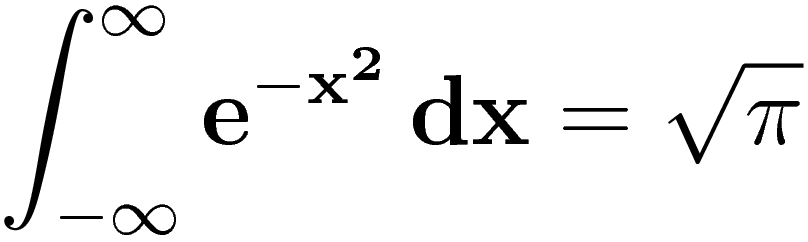
These formulas, for what they are representing are very very similar. They have the same curvature and are over the same interval.
The discrepancy between the two is the computed integrals. The normal distribution will have an area under its curvature of 1 (obviously), and the area under the Gaussian Integral I just presented is the square root of pi. The area of the Gaussian Integral can be easily proved with this method.

so anyway my question......
is there any bridge between these formulas?
where mu is the average (or first moment about the origin) and lowercase sigma is standard deviation (or square root of variance)
This is a probability distribution, so the area under this curve over the entire interval is going to be 1.
OK that's easy peasy, but a while ago I remember stumbling upon this formula.... the Gaussian Integral (not to be confused with Gaussian Distribution)
These formulas, for what they are representing are very very similar. They have the same curvature and are over the same interval.
The discrepancy between the two is the computed integrals. The normal distribution will have an area under its curvature of 1 (obviously), and the area under the Gaussian Integral I just presented is the square root of pi. The area of the Gaussian Integral can be easily proved with this method.
so anyway my question......
is there any bridge between these formulas?






Comment