
This time not stupid math

Collapse
X
 
  • Time
  • Show
Clear All
new posts
  • SKG_Scintill
    Spun a twirly fruitcake,
    FFR Simfile Author
    • Feb 2009
    • 3876

    #1

    This time not stupid math

    But it is a problem.
    I'll leave out the context, because it's a bit extensive.

    These are the sequences I'm using:
    Triangular numbers:
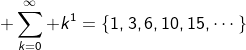
    Square pyramidal numbers:

    (Does it have a name?) numbers:

    And so on and so on, each time increasing the power.

    ---

    These are (respectively) the formulas for the first two sequences:
    Triangular numbers:
    Square pyramidal numbers:

    Now what I want to know:
    1. Does the third sequence have a name? :P
    2. What is the formula for the third sequence?
    3. How do you translate the formula of one sequence into the formula of the next sequence?

    I've tried a trial-and-error method, but that's prone to fail anyway. Does anyone know how to do it mathematically?

    ---

    P.S.: why are \cdots acting up? Solved it, not sure how.
    Last edited by SKG_Scintill; 03-20-2013, 06:25 AM.


    Originally posted by bluguerilla
    So Sexy Robotnik (SKG_Scintill) {.0001/10} [--]
    ___
    . RHYTHMS PR LAYERING
    . ZOMG I HAD TO QUIT OUT TERRIBLE
    .
  • Netjet!
    Sic itur ad astra
    FFR Simfile Author
    • Jan 2008
    • 4701

    #2
    Re: This time not stupid math

    Originally posted by SKG_Scintill
    (Does it have a name?) numbers:
    And so on and so on, each time increasing the power.

    100 = 13 + 23 + 33 + 43 = 102, a square and also a sum of consecutive cubes. If you add more cubes, the results are always squares: 100+53 = 225 = 152; 225+63 = 441 = 212; 441+73 = 784 = 282, and so on. These numbers (1, 9, 36, 100, 225, 441, 784, ...) are "hyper-pyramidal" numbers (Sloane's A0537 or MCS3872). Their square roots (1, 3, 6, 10, 15, 21, 28, ...) are the triangular numbers.
    OEIS,integer sequences,Sloane

    ^^
    RIP Steve Van Ness <3

    Comment

    • SKG_Scintill
      Spun a twirly fruitcake,
      FFR Simfile Author
      • Feb 2009
      • 3876

      #3
      Re: This time not stupid math

      Good to know they have a name, but I'm struggling to find the formula through the horrendous font


      Originally posted by bluguerilla
      So Sexy Robotnik (SKG_Scintill) {.0001/10} [--]
      ___
      . RHYTHMS PR LAYERING
      . ZOMG I HAD TO QUIT OUT TERRIBLE
      .

      Comment

      • smartdude1212
        2 is poo
        FFR Simfile Author
        • Sep 2005
        • 6687

        #4
        Re: This time not stupid math

        I believe the formulae can be found using generating functions but that is perhaps a little more difficult than what you would like. Just look up almost anything related to Riemann sum integration and you should be able to find the formula.

        Comment

        • SKG_Scintill
          Spun a twirly fruitcake,
          FFR Simfile Author
          • Feb 2009
          • 3876

          #5
          Re: This time not stupid math

          Will do, but I think it might get hairy, since I need to get up to k^100
          While wrecking my wrists, I'll find a different approach


          Originally posted by bluguerilla
          So Sexy Robotnik (SKG_Scintill) {.0001/10} [--]
          ___
          . RHYTHMS PR LAYERING
          . ZOMG I HAD TO QUIT OUT TERRIBLE
          .

          Comment

          • SKG_Scintill
            Spun a twirly fruitcake,
            FFR Simfile Author
            • Feb 2009
            • 3876

            #6
            Re: This time not stupid math

            Originally posted by SKG_Scintill
            I'll leave out the context, because it's a bit extensive.
            Well I skipped some parts to the solution of the "context":

            So I got that part done with by leaving the actual solution open.

            I'm still interested in the solution of the OP, though
            Riemann sum integration's gonna take me a while to understand.

            P.S.: (I love P.S.'es) I don't think I'm allowed to just add the two summations together and say it's (n+1)(on the formula in this post that is).
            Edit: I changed the formula again. I got the actual "put into google to make it solve it" equation. Turning it into a formula isn't exactly the easiest thing...
            Last edited by SKG_Scintill; 03-20-2013, 10:22 AM.


            Originally posted by bluguerilla
            So Sexy Robotnik (SKG_Scintill) {.0001/10} [--]
            ___
            . RHYTHMS PR LAYERING
            . ZOMG I HAD TO QUIT OUT TERRIBLE
            .

            Comment

            • iironiic
              D6 FFR Legacy Player
              FFR Simfile Author
              • Jan 2009
              • 4342

              #7
              Re: This time not stupid math

              Here (third row, third picture) is a proof without words.

              The sum of the first n cubed numbers is equal to the square of the first n numbers. Therefore,


              There might be more proofs of this, but this is one I thought of immediately haha.

              Comment

              • SKG_Scintill
                Spun a twirly fruitcake,
                FFR Simfile Author
                • Feb 2009
                • 3876

                #8
                Re: This time not stupid math

                You and your college education

                Still, that's the second question answered. So thanks!
                Yet, you made that third question a whole lot more difficult to see...

                1.

                2.

                3.

                HNNNNNG
                Though I have a feeling even and odd powers follow different formulas
                Last edited by SKG_Scintill; 03-20-2013, 10:41 AM.


                Originally posted by bluguerilla
                So Sexy Robotnik (SKG_Scintill) {.0001/10} [--]
                ___
                . RHYTHMS PR LAYERING
                . ZOMG I HAD TO QUIT OUT TERRIBLE
                .

                Comment

                • iironiic
                  D6 FFR Legacy Player
                  FFR Simfile Author
                  • Jan 2009
                  • 4342

                  #9
                  Re: This time not stupid math

                  For the third question, you can use generating functions and convolutions to determine this. This is a good practice problem for my Combinatorics midterm tomorrow :P

                  I'll get back onto that soon!

                  Comment

                  • SKG_Scintill
                    Spun a twirly fruitcake,
                    FFR Simfile Author
                    • Feb 2009
                    • 3876

                    #10
                    Re: This time not stupid math

                    That's interesting given that my current math class is combinatorics, only community college level


                    Originally posted by bluguerilla
                    So Sexy Robotnik (SKG_Scintill) {.0001/10} [--]
                    ___
                    . RHYTHMS PR LAYERING
                    . ZOMG I HAD TO QUIT OUT TERRIBLE
                    .

                    Comment

                    • qqwref
                      stepmania archaeologist
                      FFR Simfile Author
                      • Aug 2005
                      • 4092

                      #11
                      Re: This time not stupid math

                      As far as I know there is no easy way to go from one sum to the next (there isn't any nice recursion of that form). All you are probably going to find is closed-form representations where you can plug in n to get the sum of k^n. There is some useful info over at http://mathworld.wolfram.com/PowerSum.html
                      Best AAA: Policy In The Sky [Oni] (81)
                      Best SDG: PANTS (86)
                      Best FC: Future Invasion (93)

                      Comment

                      • SKG_Scintill
                        Spun a twirly fruitcake,
                        FFR Simfile Author
                        • Feb 2009
                        • 3876

                        #12
                        Re: This time not stupid math

                        Doesn't that mean that someone can graduate from college by figuring it out?


                        Originally posted by bluguerilla
                        So Sexy Robotnik (SKG_Scintill) {.0001/10} [--]
                        ___
                        . RHYTHMS PR LAYERING
                        . ZOMG I HAD TO QUIT OUT TERRIBLE
                        .

                        Comment

                        • benguino
                          Kawaii Desu Ne?
                          • Dec 2007
                          • 4186

                          #13
                          Re: This time not stupid math

                          I'd call that last one "snowman" numbers if I could, haha (you'd just have different sized cubes instead of spheres xP)
                          AMA: http://ask.fm/benguino


                          Originally posted by Spenner
                          (^)> peck peck says the heels
                          Originally posted by Xx{Midnight}xX
                          And god made ben, and realized he was doomed to miss. And said it was good.
                          Originally posted by Zakvvv666
                          awww :< crushing my dreams; was looking foward to you attempting to shoot yourself point blank and missing

                          Comment

                          • Zapmeister
                            FFR Player
                            • Sep 2012
                            • 466

                            #14
                            Re: This time not stupid math

                            Ok i think i have a shot at this.

                            iironiic got the formula for the sum of the first n cubes right, but it seems you're looking for a general formula for the sum of the first m-th powers in general, it's kind of convoluted.

                            Most of what i'm about to write is described in more detail here: http://www.cs.purdue.edu/homes/dglei...20calculus.pdf (skip section 2)

                            Your motivation: to find the sum of the first n m-th powers in general. So let's say you want to find the sum of the first n cubes, like you said in the OP. Wouldn't it be nice if writing the sum was a bit like writing an integral? You could pretend you're integrating x^3 instead of summing k^3 from 1 to n.

                            Unfortunately, that doesn't work. If you integrate x^3, you get x^4/4, and that's not the same as iironiic's formula x^2*(x+1)^2/4. Oh well. What do we do instead? Well it's pretty close, I mean you've got your 4th degree polynomial, and you've got your divide-by-4, so maybe you could find some way to rectify that situation.

                            Define the finite difference D f(x) of a function f(x) to be:
                            D f(x) = f(x+1) - f(x)
                            (the article uses a triangle symbol, but i'm seriously not bothered with getting out character map for this, so i'll stick with D)
                            It's a bit like taking the derivative by doing the difference quotient (f(x+h)-f(x))/h, except instead of letting h->0, you let h->1.

                            Examples:
                            What's D x? answer: D x = (x+1) - (x) = 1
                            What's D x(x-1)? answer: D x(x-1) = (x+1)x - x(x-1) = 2x
                            What's D x(x-1)(x-2)? answer: ok you can work it out yourself. it's 3x(x-1)
                            What's D x(x-1)(x-2)(x-3)? answer: it's 4x(x-1)(x-2)

                            It's a case of spot the pattern. You've got these things on the left that look like powers, but slightly different, and on the right, when you take the finite difference, they behave like you're doing a differentiation. It makes sense if you give these things a name. We call them "falling powers" and write x^k for x(x-1)(x-2)...(x-k+1). Then you get this rule

                            D x^k = k x^k-1

                            Proof: work it out yourself, or check theorem 3.1

                            Ok, so you've got your analogue of differentiation. What's integration? That's basically just summation. We distinguish between the indefinite sum and the definite sum (article says "discrete anti-derivative" for the latter... never heard of it). The indefinite sum is just your finite difference, but backwards.

                            sum k x^k-1 = x^k + Y, where Y is a constant which stands for "Y do we care?", because it's a complete irrelevance.

                            The definite sum is like this but you put limits in it. Here you have to be careful. It turns out that this is true:

                            sum from x=a to b D f(x) = f(b+1) - f(a).

                            There's a b+1 in the upper limit, not a b. That's because of the x+1 in the definition of the finite difference.
                            Proof: write D f(x) = f(x+1) - f(x) and write out the sum and then all the terms in the middle cancel out and you're left with f(b+1) from the upper limit and f(a) from the lower limit.

                            So now you've got the basic concepts of "differentiation and integration" down for this finite-difference case. What can we do with them? Read the article for more stuff about it, but you can create analogues of the product rule, and integration by parts, and e^x, and stuff, for the finite case. The falling-power formula also works for negative powers too. (see sections 3.5 and 3.6)

                            Back to what we started with: finding the sum of k^3 from 1 to n. The plan: rewrite k^3 in terms of falling powers, pretend to integrate them, and then rewrite your answer back in terms of normal-flavoured powers. That's all well and good, until you realise you don't have a general way to do the first step. Here's where Stirling numbers come in.

                            Stirling numbers: Define the Stirling number of the second kind {n,k} to be the coefficient of x^k in the falling power expansion of x^n. Like this:
                            x^n = sum from k=0 to n of {n,k}*x^k

                            I'll leave you to read the relevant bits of the article for the actual definition and a bunch of amazing properties that you automatically get with Stirling numbers of the second kind. For your purposes, here are the first few:

                            x^1 = x^1
                            x^2 = x^2 + x^1
                            x^3 = x^3 + 3 x^2 + x^1
                            x^4 = x^4 + 7 x^3 + 6 x^2 + x^1

                            and you get this nice little triangle (Stirling's triangle)
                            (k=... 1 2 3 4)
                            (n=1) 1
                            (n=2) 1 1
                            (n=3) 1 3 1
                            (n=4) 1 7 6 1
                            and to get {n,k} the formula is {n,k} = k*{n-1,k} + {n-1,k-1}. Have fun drawing the triangle out a bit like Pascal's triangle.

                            So if you wanted to find the sum of k^3 from 1 to n, you'd write:

                            x^3 = x^3 + 3 x^2 + x^1
                            pretend to integrate: x^4/4 + x^3 + x^2/2
                            your limits are 1 and n+1, but your lower limit 1 doesn't do anything because your falling powers all have a zero in them, so you get (n+1)^4/4 + (n+1)^3 + (n+1)^2/2
                            = (n+1)(n)(n-1)(n-2)/4 + (n+1)(n)(n-1) + (n+1)(n)/2
                            = (n+1)(n)[(n-1)(n-2)/4 + (n-1) + 1/2]
                            = (n+1)(n)[(n^2-3n+2)/4 + n - 1/2]
                            = (n+1)(n)[(n^2+n)/4]
                            = n^2*(n+1)^2/4

                            voila.

                            If you wanted to get the sum of k^4 from 1 to n, just... do the same thing, I guess. You should get:
                            n(n+1)(2n+1)(3n^2+3n+1)/30

                            But your question was about getting from one formlula to the next. So what you could do is do the above process backwards, then change the Stirling coefficients, then do it forwards again. But seriously, I can't see ANY REASON AT ALL as to WHY anyone would want to do that. It would be twice as fast to just get the formula straight off the above method for each case. (edit: Actually, no, ignore that. Finding the new Stirling numbers from the recursion is MUCH FASTER than working them straight out. Silly me.) (edit 2: Actually, no. Retract that edit, since you're going to need to do the Stirling number computation anyway to do step 1 of the below. So it's still twice the effort.) But I'm not one to question your motives, so here we go.


                            ...

                            Ok, so for the answer to the question: How to get from one formula to the next?
                            answer:
                            (1) convert your answer into falling powers
                            (2) take the finite difference of each one (i.e. "pretend to differentiate")
                            (3) change the Stirling numbers according to the formula {n,k} = k*{n-1,k} + {n-1,k-1}
                            (4) take the indefinite sum of each one (i.e. "pretend to integrate")
                            (5) substitute x=n+1 and expand out
                            (edit 5: on second thoughts this method is probably too impractical)

                            but seriously though. Why do you want to do this?


                            edit 3: OH MY GOD. DAMN DAMN DAMN DAMN DAMN DAMN. I didn't realise you could do this: http://www.trans4mind.com/personal_d...ralNumbers.htm If you only wanted a recursive formula, you can basically forget everything I wrote in the rest of this post. I can't believe I just wasted like 30 mins.

                            *headdesk*

                            edit 4: typos and stuff
                            Last edited by Zapmeister; 03-20-2013, 01:10 PM.

                            Theorem: If you have a large enough number of monkeys, and a large enough number of computer keyboards, one of them will sight-read AAA death piano on stealth. And the ffr community will forever worship it. Proof Example

                            ask me anything here

                            mashed FCs: 329

                            r1: 5
                            r2: 4
                            r3: 6
                            r4: 8
                            r5: 3
                            r6: 5
                            r7: 15
                            final position: 4th

                            Comment

                            • SKG_Scintill
                              Spun a twirly fruitcake,
                              FFR Simfile Author
                              • Feb 2009
                              • 3876

                              #15
                              Re: This time not stupid math

                              Ouch, that's rough, but it was kind of what I was expecting.

                              Originally posted by Zapmeister
                              but seriously though. Why do you want to do this?
                              The possible solutions for "x ∈ ℕ" people throwing a dice with "y ∈ ℕ" sides where a person wins on the first dice throw. Leaving out ties, obviously.

                              11 12 13 14 15 16
                              21 22 23 24 25 26
                              31 32 33 34 35 36
                              41 42 43 44 45 46
                              51 52 53 54 55 56
                              61 62 63 64 65 66

                              1+2+3+4+5

                              111 112 113 114 115 116
                              121 122 123 124 125 126
                              131 132 133 134 135 136
                              141 142 143 144 145 146
                              151 152 153 154 155 156
                              161 162 163 164 165 166

                              211 212 213 214 215 216
                              221 222 223 224 225 226
                              231 232 233 234 235 236
                              241 242 243 244 245 246
                              251 252 253 254 255 256
                              261 262 263 264 265 266

                              311 312 313 314 315 316
                              321 322 323 324 325 326
                              331 332 333 334 335 336
                              341 342 343 344 345 346
                              351 352 353 354 355 356
                              361 362 363 364 365 366

                              411 412 413 414 415 416
                              421 422 423 424 425 426
                              431 432 433 434 435 436
                              441 442 443 444 445 446
                              451 452 453 454 455 456
                              461 462 463 464 465 466

                              511 512 513 514 515 516
                              521 522 523 524 525 526
                              531 532 533 534 535 536
                              541 542 543 544 545 546
                              551 552 553 554 555 556
                              561 562 563 564 565 566

                              611 612 613 614 615 616
                              621 622 623 624 625 626
                              631 632 633 634 635 636
                              641 642 643 644 645 646
                              651 652 653 654 655 656
                              661 662 663 664 665 666

                              1+4+9+16+25

                              You can see where this is going; 4 people is going to take too long to type.

                              ---

                              You can solve these by putting the summation in a calculator, sure. But it gets a bit long when you're working with 20 people and chances between 1 and 100. Or rather: "x ∈ ℕ" people with "y ∈ ℕ" options.
                              That's why I was trying to expand the already existing formulas of triangular numbers and square pyramidal numbers to figurate number sequences of n-dimensional pyramids.
                              Last edited by SKG_Scintill; 03-20-2013, 12:05 PM.


                              Originally posted by bluguerilla
                              So Sexy Robotnik (SKG_Scintill) {.0001/10} [--]
                              ___
                              . RHYTHMS PR LAYERING
                              . ZOMG I HAD TO QUIT OUT TERRIBLE
                              .

                              Comment

                              Working...