PDA

View Full Version : [High School - Precalc] Mouse Problem - easy shortcut I am missing?


aTzUeLo1191
11-25-2008, 07:43 PM
I'll try and sum up the problem so I don't have to type up a long paragraph:

2 mice are on an island with unlimited food and no predators. They have 6 children on the first day, 3 M, 3 F, and reproduce the same every 40 days after that. Children reproduce after 120 days, every 40 days. How many mice will there be after 1 year?

Is there a really simple shortcut I am missing? A problem like this is kinda tough to write out every stage at a time.

tha Guardians
11-25-2008, 08:47 PM
Are mice able to inbreed?
Your shortcut has been found xD

aTzUeLo1191
11-25-2008, 08:50 PM
So yeah, there is a ****load of inbreeding going on, and eventually some mice will be born w/o the proper parts to reproduce, but seriously, I'm looking for a shortcut to check my answer.

tha Guardians
11-25-2008, 08:58 PM
So yeah, there is a ****load of inbreeding going on, and eventually some mice will be born w/o the proper parts to reproduce, but seriously, I'm looking for a shortcut to check my answer.

Well I might not have helped you (unless it was a trick question), but I think I helped bring attention to your thread, which in turn may lead you to the answer.

That's right.
You're welcome.

jk

igotrhythm
11-25-2008, 09:31 PM
Instead of thinking in terms of the number of mice, try thinking in terms of the number of breeding pairs of mice. Besides making the numbers smaller and thus making it easier to recognize patterns (you mentioned that it was getting tedious doing it step by step), it also leads into discussion of one of my favorite mathematical sequences, which was derived from a very similar problem.

At time 0, there is 1 breeding pair plus 3 immature pairs. The first mature breeding pair kicks out another 3 immature pairs at t=40 and t=80, giving 1 breeding pair plus 9 immature pairs at 80 days.

However, at t=120 days, we have 2 breeding pairs, and mice being the animals they are, they immediately get to work and pop out another 3 immature pairs. So we have 2 mature pairs and 15 immature. At t=160, there's 3 mature and 24 immature, and so on.

Since 1 year is approximately t=360 in this system, we have as follows (white text alert):
Number of mature breeding pairs: 1, 1, 1, 2, 3, 5, 8, 13, 21, 34
Number of immature breeding pairs: 3, 6, 9, 15, 24, 39, 63, 102, 165, 267

If the sequence of numbers of mature breeding pairs for given values of t looks familiar, the pattern should help you with how I derived the number of immature pairs.

dooey100
11-25-2008, 10:48 PM
I'm assuming that by shortcut you mean not brute forcing all the numbers.

This is like the Fibonacci Sequence, where every number is the sum of the two before it. There is a formula for finding any number in the sequence, but if your teacher hasn't given it too you, I doubt they expect you to use it. Here it is: http://upload.wikimedia.org/math/9/6/8/968be88f42e32712cb10d89a765ce708.png

Note that it works if the series starts 0, 1, 1, 2, 3, 5 so you would have to modify the function a bit to fit your problem.
(the swirl symbol = phi = (1+sqrt(5))/2 = about 1.618)

QED Stepfiles
11-26-2008, 01:46 AM
So, basically, the easiest "non-brute force" way of solving this is to first define the system recursively (i.e. how many mice are present at t_{n+1} as a function of how many mice there are at t_{n} and t_{n-1} and so on), and then to "decouple" the recursion (i.e. be able to write it as just a function of "n") using eigenvalues. Since this is a high school precalculus course, though, that would not really be an option...

In other words, I'm pretty sure you are meant to brute force this problem. If you want to know how to do this problem without just plugging in the numbers, take a linear algebra course in the future. But for now, I think you may have to just be satisfied with being able to enter in numbers into your calculator =/.

MeaCulpa
11-26-2008, 08:16 AM
You don't really have to do accounting every 40 days. Here's how I would interpret this (sorry if I screwed something up):

1 female gives birth 10 times: 0 40 80 120 160 200 240 280 320 360.

The 3 females born on day 0 give birth 7 times: 120 160 200 240 280 320 360.

The 3 females born on day 40 give birth 6 times: 160 200 240 280 320 360.

The 3 females born on day 80 give birth 5 times: 200 240 280 320 360.

There are 6 females born on day 120, each giving birth 4 times: 240 280 320 360.

9 females were born on day 160, each giving birth 3 times: 280 320 360.

12 born on 200, giving birth twice: 320 360.

15 born on 240, giving birth once: 360.


(1 x (10 x 6)) + (3 x (7 x 6)) + (3 x (6 x 6)) + (3 x (5 x 6)) + (6 x (4 x 6)) + (9 x (3 x 6)) + (12 x (2 x 6)) + (15 x (1 x 6))

aTzUeLo1191
11-26-2008, 02:09 PM
Ok, thanks for the help all, but I don't really understand the first 3 methods, and the answer for the fourth is too small.

I basically made a chart that had adults, children born that phase, 40 day old children, and 80 day old children. Then I just moved the numbers down the line, with the adults multiplying by 3 to get the newborn children (2 adults per 6 children). I got 1764, so if anyone else got that number, sweet.

igotrhythm
11-26-2008, 05:11 PM
I don't know what one of us is doing wrong...I ended up with only 602. >_<

aTzUeLo1191
11-26-2008, 06:01 PM
I think you are forgetting that the children have children, then those children have children, but the first set still has more children.

3 different classes got the same problem. I've probably asked about 15-20 people, and no 2 answers were alike. It's much trickier than it seems.

Gilly G
11-26-2008, 06:22 PM
Mea's method seems correct when elaborated as such. You end up with 924, seems reasonable.

MeaCulpa
11-26-2008, 06:23 PM
Oh right, my method is alright, but I undercounted starting day 240. My answer comes out to a little more than yours, though:

The two mice in the beginning = 2
That first female gives birth 10 times = 60
3 give birth 7 times starting on day 120 = 3 x 7 x 6 = 126
3 give birth 6 times starting on day 160 = 3 x 6 x 6 = 108
3 give birth 5 times starting on day 200 = 3 x 5 x 6 = 90

On day 240 though, the 3 females born from the "Adam and Eve" mice, as well as the 9 females born on day 120 (whose 'grandparents' were born on day 0) give birth 4 times each (240, 280, 320, 360)...so 12 x 4 x 6 = 288.

There were a total of 21 females born on day 160, so there are 21 x 3 x 6 = 378 new mice from females who can start giving birth on day 280.

30 females born on day 200, so 30 x 2 x 6 = 360 new mice from females starting on day 320.

Finally, a total of 66 females were born on day 240 (3+9+9+9+36), so 66 x 1 x 6 = 396 mice from females that could being reproducing on day 360.

Add 'em up: 2 + 60 + 126 + 108 + 90 + 288 + 378 + 360 + 396 = 1806 on the 365th day.

Again, if I didn't explain something well, let me know.

trumaestro
11-26-2008, 07:15 PM
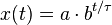
Exponential growth. Should be able to sub into this formula http://upload.wikimedia.org/math/3/0/4/304677d0a2a761f33ac0ab4725fabd2f.png, where a is the starting amount, b is the rate of growth, and T is the time it takes to achieve the growth rate.
Your question isn't very clear, but I think you should be able to use the formula with 2 for a, 3 for b (as the population triples), and one of either 40 or 120 for T. Put 365 for x and solve for t using logs or graph intersection.
That's the method that makes most sense to me.

emerald000
11-26-2008, 09:26 PM
We would have to use recursion mathematics. Let's be m_n the number of mices at generation n and f_n the number of reproducting females.

Let be m_0=2 and f_0 = f_1 = f_2 = 1.

So, the number of mices m_n is given by:

m_n = m_(n-1) + 6 f_(n-1) for n=1,2,3,4,...

and the number of reproductive females by:

f_n = f_(n-1) + 3 f_(n-3) for n=3,4,5,...

So, in a year, there would be 9 generations. With a little recursion, you can arrive at m_9=974 with f_9=139.

I guess I'm pretty much on the mark, but feel free to bash my theory to death.

aTzUeLo1191
11-26-2008, 11:27 PM
@Meaculpa: Your method seems right too...perhaps I just made some addition mistake. I'll have to see when I get the problem back.

@Trumaestro: I'm not really sure how to use the equation because B isn't 3. I don't any idea what to put in for that variable

@emerald: You lost me at "recursion mathematics".

I should get the answer w/ a method on Monday; perhaps someone here is right after all.

Commandersa1
11-27-2008, 02:22 AM
I got 1550. :/

This was my method:

http://img367.imageshack.us/img367/5570/micekb2.jpg

I cannot see how I could mess up, and igotrhythm got close to that answer too.

QED Stepfiles
11-27-2008, 01:04 PM
OK Let’s try this using matrices… since everybody seems to be getting different answers.

First we have to come up with a recursion. We have that

M_n = m_{n-1} + 3m_{n-3}

In other words, the number of mice at time n is equal to the number of mice from time n-1 added to the number of mature mice, which is m_{n-3}, multiplied by 6 (how many mice are produced by each pair), divided by 2 (because we need a pair of mice to reproduce).

So, the matrix for this equation is

1 0 3
1 0 0
0 1 0

Call this matrix A.

So, generally from here we would find eigenvalues to decouple the equation… but just from inspection I’m pretty sure there are complex eigenvalues and I don’t want to chug through the math…

Basically, this matrix when multiplied by a vector that describes how many mice there are at three subsequent times (say, 1,2,3), will give you how many mice there are at 2,3,4. You can check this if you want. Multiply the matrix on the right by a column vector (a3, a2, a1), and you'll get out the result

(a3+3a1, a3, a2) which is precisely the description of how many mice there are at (a4, a3, a2)

The number of mice there are at times 1,2,3 is 8, 14, 20.

We want to find the mice at time 9 (since this is precisely one year later). Therefore, we just multiply A^6 * (8,14,20), since we would like to go from time 3 to time 9, which requires 6 applications of our matrix.

We can use a calculator to do this, and we get:

974, 536, 278

Meaning, after a year there are 974, after 320 days there are 536, and after 280 days there are 278.

We could continue this if you like... if you would like to figure out how many mice there are after 40*n days, just multiply the vector (8,14,20) by A^(n-3) on the left, and the first number is your answer.

Basically, matrix multiplication makes everything easier.

=D

So yes, 974 is the correct answer. I’m 100% sure.

Hope this helps.

emerald000
11-27-2008, 06:44 PM
You should have kept on reading after that, it isn't as hard as it seem. Suppose we want to find the number of mice at generation 5. We would need to find m_4. (m_0 being the first one)

In recursive mathematics, all you need to do is to apply the formula(s) a lot of times in order to simplify to data you know. Here we will start with m_4, and try to end with m_0, f_0, f_1 and f_2. It can get quite messy once you start to try higher numbers, so the usage of a computer is often useful to speedup the process.

Given that m_n = m_(n-1) + 6 f_(n-1) and f_n = f_(n-1) + 3 f_(n-3), and that m_0=2 and f_0=f_1=f_2=1

m_4 = m_3 + 6 f_3
m_4 = (m_2 + 6 f_2) + 6 (f_2 + 3 f_0)
m_4 = ((m_1 + 6 f_1) + 6 f_2) + 6 (f_2 + 3 f_0)
m_4 = (((m_0 + 6 f_0) + 6 f_1) + 6 f_2) + 6 (f_2 + 3 f_0)

We know the value of m_0, f_0, f_0 and f_0. All we have to do now is to put the values back into that equation.

m_4 = (((2 + 6 (1)) + 6 (1)) + 6 (1)) + 6 ((1) + 3 (1))
m_4 = 44

---

I also doubt that linear algebra is going to help him much in his problem...

QED Stepfiles
11-27-2008, 11:40 PM
Emerald's method is completely correct, but the problem is that it's just really... really... really messy. Even with a computer, it's much easier to just reorganize the problem in terms of a matrix multiplication, and just to go from there. After all, telling a computer to raise a square matrix to some integral power is much easier than asking it to solve a recursion. Both methods definitely work, though.

In terms of matrix multiplication, however, if you want a convenient online program to do it for you, try here:

http://wims.unice.fr/wims/en_tool~linear~matmult.html

Good luck!

And by the way, the reason why linear algebra would help is that if we can find a basis of eigenvectors that correspond to the matrix that describes the recursion, we can diagonalize the matrix, and diagonal matrices are really easy to work with (if you raise it to a power "n", then just raise each element down the diagonal to a power "n"). As far as I know, it's probably the most elegant solution to this problem, and it doesn't require a computer to solve at all (you just need to find the roots to some polynomials, and in a 3x3 case that's easy enough to do by hand). This is precisely how one would try to find an explicit expression for the Fibonacci sequence (that's actually an easier problem, since that's only a 2x2 matrix and 2nd degree polynomials are easily solved by the quadratic formula).

MeaCulpa
11-28-2008, 10:17 AM
Hmm...I agree with emerald's f_9 value:

1 female initially (reproduces 10 times)
3 born on 0 (each reproduce 7 times)
3 born on 40 (each reproduce 6 times)
3 born on 80 (each reproduce 5 times)
12 born on 120 (each reproduce 4 times)
21 born on 160 (each reproduce 3 times)
30 born 200 (each reproduce 2 times)
66 born on 240 (each reproduce once)
___
139 reproductive females by day 360.

But I don't think 974 is high enough of a value, considering the number of times each can reproduce:

(1 x (10 x 6)) + (3 x (7 x 6)) + (3 x (6 x 6)) + (3 x (5 x 6)) + (12 x (4 x 6)) + (21 x (3 x 6)) + (30 x (2 x 6)) + (66 x (1 x 6)) = 1806.

igotrhythm
11-28-2008, 07:23 PM
Haha, this is good stuff...all the different solutions we've come up with. XD

You should show your teacher this on Monday and give out credits to anyone that ends up being right.

aTzUeLo1191
12-8-2008, 04:55 PM
Bumping w/ answer.

Teacher finally gave it back today, one or two people in our class got it right - 1808. Sadly, no one here did, and neither did I.

I didn't get a method on how he or anyone else found it, but if you all want, I could ask him.

Edit: Damn I just noticed Mea was pretty close...did you forget to add the two parents?

MeaCulpa
12-8-2008, 08:45 PM
Oh, yeah I guess I did. Just looking at my calculation in my last post, I calculated the total progeny without Adam and Eve. I guess it wouldn't hurt to find out how exactly he solved it, and if there is a proper shortcut after all.

Commandersa1
12-8-2008, 11:20 PM
I would like to know the actual process in solving this. :/

Patashu
12-9-2008, 12:18 AM
I'll try and sum up the problem so I don't have to type up a long paragraph:

2 mice are on an island with unlimited food and no predators. They have 6 children on the first day, 3 M, 3 F, and reproduce the same every 40 days after that. Children reproduce after 120 days, every 40 days. How many mice will there be after 1 year?

Is there a really simple shortcut I am missing? A problem like this is kinda tough to write out every stage at a time.

Looks like an iterative function to me. A pair of mice produce three reproducing pairs that kick in three steps later, so let's have f_n counting the number of reproducing mice pairs and g_n counting the total number of mice at any given 40 day interval.
f_0, f_1, f_2 = 1
g_0 = 8

f_n = f_(n-1) + 3*f_(n-3) (the mice pairs from exactly 120 days ago are considered breeders from this term on)
g_n = g_(n-1) + 6*f_n (calculate this after calculating f_n)

f_3 = 4
f_4 = 7
f_5 = 10
f_6 = 22
f_7 = 43
f_8 = 73
f_9 = 139

g_1 = 14
g_2 = 20
g_3 = 44
g_4 = 86
g_5 = 146
g_6 = 278
g_7 = 536
g_8 = 974
g_9 = 1808

So after 360 days there are 1808 mice. After 365.251 days there will still be 1808 mice ;)

QED Stepfiles
12-9-2008, 11:34 AM
Ah ****... I forgot that we start at time zero, not at time one...

If you take the matrix that I have in my post and take it to the 7th power rather than the 6th, you get the correct answer.

Whoops...

emerald000
12-9-2008, 02:20 PM
And using m_10 with my recursion formula. At least I know my technique works (and the one Patashu posted since it is the exact same one).