PDA

View Full Version : [High School -Physics] Resistor Networks


sayuncle990
11-1-2008, 08:54 PM
First of all, sorry if this is in the wrong forum. I didn't see any other place to put it.

So I got this homework to do, and I've pretty much figured it all out using a bus diagram, except for one part. I don't know how to approach Resistors 7 through 9 and 10 through 12. The only idea that I have is that they equalize between 7 and 8, and 10 and 11. If anyone actually knows how to approach this, I would very grateful for any help. Thanks.
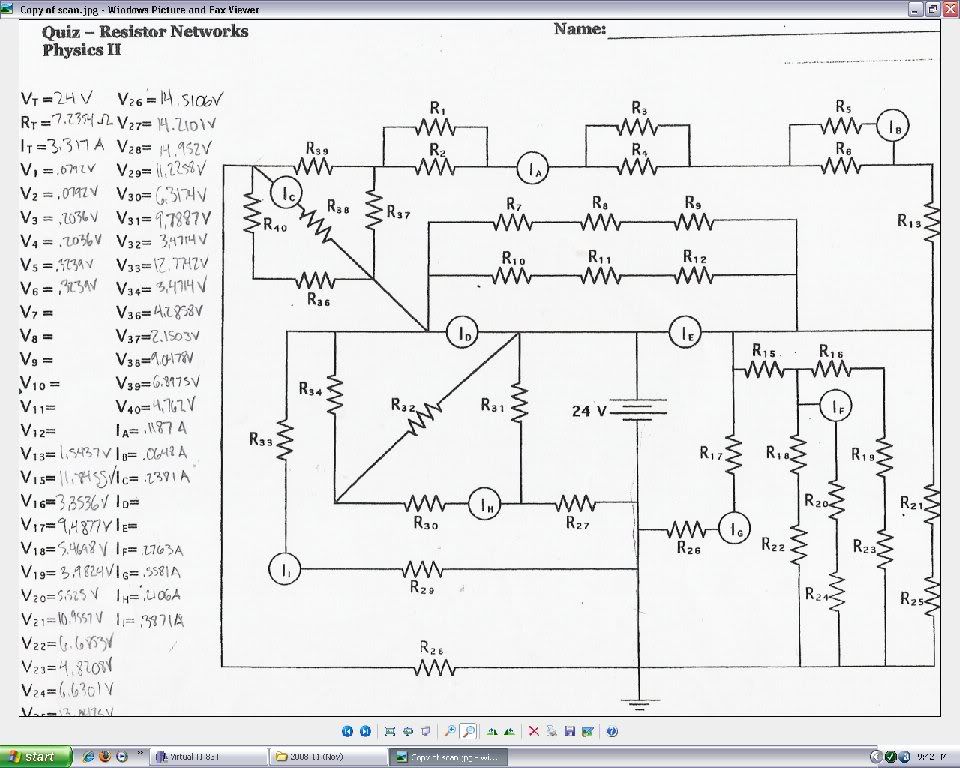
http://i283.photobucket.com/albums/kk307/Sanctam/untitled-1.jpg

This is the only idea I have as far as a bus diagram:
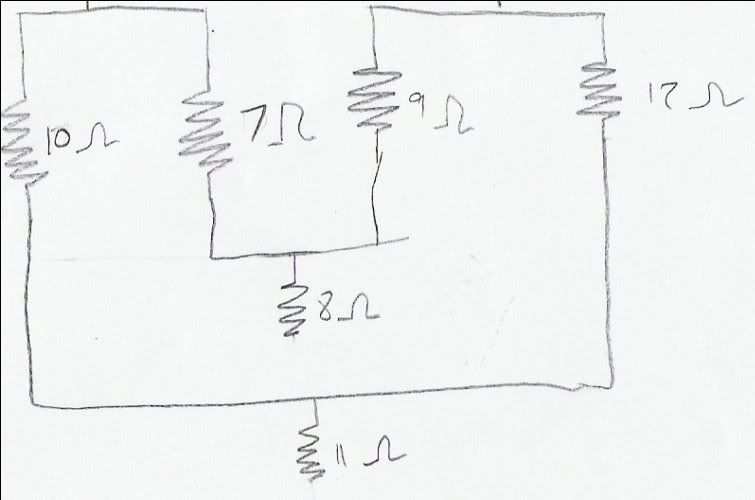
http://i283.photobucket.com/albums/kk307/Sanctam/Phys2.jpg

One last thing: Just a check on how to find the currents at E and D: Do I just add up all the currents traveling along each separate loop?

robertsona
11-1-2008, 09:06 PM
Critical Thinking>Homework Help

sayuncle990
11-1-2008, 09:10 PM
Sorry then, I saw

Critical Thinking (3 Viewing)
An area specifically for higher-level thinkers. Debates, Essays, Politics etc.

And thought that homework wasn't the right area. Is there anyway I can move it? Or does a mod have to do that?

sumzup
11-1-2008, 09:16 PM
A mod will have to do that. PM devonin or squeek (they're online right now); they should be able to do it.

rzr
11-1-2008, 09:18 PM
Don't bother.

Izzy
11-1-2008, 11:28 PM
I doubt many people are willing to do more homework then they are already given.

devonin
11-2-2008, 01:27 AM
Don't bother.

Dude, shut it. Don't tell people not to bother using a forum for its express intended purpose. If -YOU- don't want to help, fine, stay out of my forum.

sn1per9mm
11-2-2008, 01:43 AM
I'm glad we have never had to work with that big of a circuit.

If I'm understanding your question correctly:
7-9 and 10-12 are series, and are both series are in parallel.

So you know that:
R(7 to 9) = R7 + R8 + R9
R(10-12) = R10 + R11 + R12

Then set them up in parallel:
[1/R(7to9) + 1/R(10to12)]^-1

sayuncle990
11-2-2008, 08:11 AM
I thought about that, but it starts and ends at 24 Volts. So how would the current react? Because if V=IR, then the current throughout that would be zero, because the drop is zero. But are you saying that that does not matter, and I can treat it as a normal parallel series?

sn1per9mm
11-2-2008, 11:07 AM
The current through it couldn't be zero because the Junction Rule states that the total current into it is equal to the total current out of it.

sayuncle990
11-2-2008, 12:16 PM
But if I treat it as a series, and come out with a 24 Ohm resistor on the top, I know the drop in voltage across that is zero volts. Using Ohm's law, it would come out as I = V(zero)/24 Ohms. This makes the current zero, and thus every drop zero volts. I don't know how else to look at it. We didn't cover any Junction Rule...But then again if the current going in is zero, then the current go out is still zero.