Daily Suspicious0bserver's Weather Post:
June 3, 2014
What's in the sky tonight?
June 3, 2014
-Look above the Moon early this evening for Regulus and Gamma (γ) Leonis, slightly fainter. They're the two brightest stars of the Sickle of Leo.
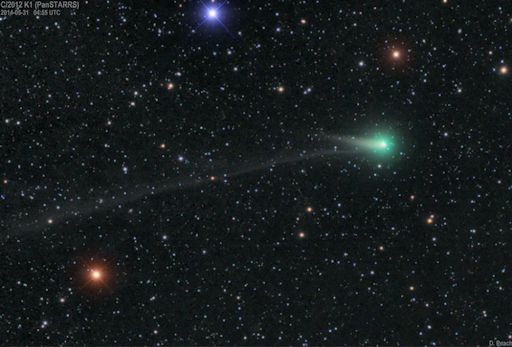
-On August 27, 2014, Comet C/2012 K1 PanSTARRS will buzz Earth's orbit only 0.05 AU away. Unfortunately for sky watchers, Earth won't be there. Our planet will be on the other side of the sun during PanSTARRS's close approach. A better time to photograph the comet is now. UK astronomer Damian Peach took this picture from his backyard observatory in Selsey, West Sussex, on May 31st. His picture highlights the comet's vivid green atmosphere or "coma". The verdant hue is a sign of diatomic carbon and cyanogen, two gases that grow green when illuminated by sunligght in the near-vacuum of space.
"The comet's long ion tail is still rather faint," notes Peach. To pull it out of the starry background required a 30 minute exposure with his 4-inch telecope.
PanSTARRS K1 is currently moving through Ursa Major, shining about as brightly as an 8th magnitude star. This makes it an easy target for mid-sized backyard telescopes, albeit invisible to the naked eye. Amateur astronomers who wish to image the comet can find orbital elements and an ephemeris here.
If Earth and the comet were on the same side of the sun in August, the view would be spectacular. Disappointment will be mitigated, only a little, by images from the Solar and Heliospheric Observatory. SOHO's C3 coronagraph will track the comet as it passes behind the sun (from our point of view) from August 2nd until August 16th.
 Astro Picture of the Day:
June 3, 2014
Source:
Astro Picture of the Day:
June 3, 2014
Source:
Might this giant pinwheel one-day destroy us? Probably not, but investigation of the unusual star system Wolf-Rayet 104 has turned up an unexpected threat. The unusual pinwheel pattern has been found to be created by energetic winds of gas and dust that are expelled and intertwine as two massive stars orbit each other. One system component is a Wolf-Rayet star, a tumultuous orb in the last stage of evolution before it explodes in a supernova -- and event possible anytime in the next million years. Research into the spiral pattern of the emitted dust, however, indicates the we are looking nearly straight down the spin axis of the system -- possibly the same axis along which a powerful jet would emerge were the supernova accompanied by a gamma-ray burst. Now the WR 104 supernova itself will likely be an impressive but harmless spectacle. Conversely, were Earth really near the center of the powerful GRB beam, even the explosion's 8,000 light year distance might not be far enough to protect us. Currently, neither WR 104 nor GRB beams are understood well enough to know the real level of danger.