 03-5-2014, 06:30 AM
|
#858
|
|
⊙▃⊙
  
Join Date: Nov 2007
Location: I live in the last place where you Look.
Age: 33
Posts: 7,376
|
 Re: Terry's Astronomy Thread.
Daily Suspicious0bserver's Weather Post:
March 5, 2014
What's in the sky tonight?
March 5, 2014
-The huge "Winter Diamond" of 2014 stands upright in the south around 8 p.m. now. It's formed by Jupiter on top and Sirius on the bottom — the two brightest points in the evening sky — and Procyon forming its left corner and Betelgeuse as its right corner.
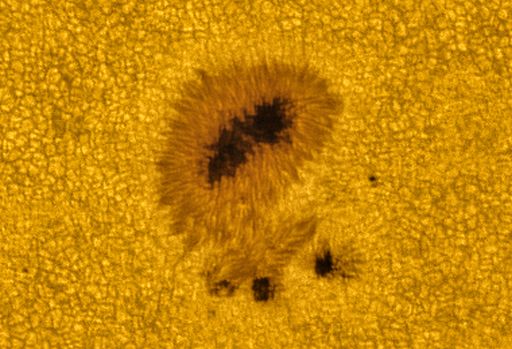
-The lifespan of a typical sunspot is two to three weeks. This one is about to turn three months. Carried around by the sun's 27-day rotation, AR1990 is making its third transit of the visible solar disk. In previous apparitions it was known as AR1944 and AR1967. Each time it has appeared, the sunspot has unleashed at least one strong flare, the most recent being the X4.9-class blockbuster of Feb. 25th. Since then, AR1990 has quieted and started showing signs of decay.
 Astro Picture of the Day:
March 5, 2014
Source:
Astro Picture of the Day:
March 5, 2014
Source:
The eggs from this chicken may form into stars. The above pictured emission nebula, cataloged as IC 2944, is called the Running Chicken Nebula for the shape of its greater appearance. The image was taken recently from Siding Spring Observatory in Australia and presented in scientifically assigned colors. Seen near the center of the image are small, dark molecular clouds rich in obscuring cosmic dust. Called Thackeray's Globules for their discoverer, these "eggs" are potential sites for the gravitational condensation of new stars, although their fates are uncertain as they are also being rapidly eroded away by the intense radiation from nearby young stars. Together with patchy glowing gas and complex regions of reflecting dust, these massive and energetic stars form the open cluster Collinder 249. This gorgeous skyscape spans about 70 light-years at the nebula's estimated 6,000 light-year distance.
|

|

|