Daily Suspicious0bserver's Weather Post:
January 2, 2014
What's in the sky tonight?
January 2, 2014
-As twilight starts to fade, look for the thin crescent Moon (24 hours older now, much easier than yesterday) above Venus low in the southwest, as shown at right. Venus too is a (tiny) crescent. The two crescents face almost the same way toward their light source, the Sun. (In parts of western North America a telescope may show the Moon's dark, Earthlit limb occulting Beta Capricorni, but the Moon will be very low and the observation difficult.)
-The brief Quadrantid meteor shower is predicted to peak around 19h or 20h UT (11 a.m. or noon Pacific Standard Time). This is good timing for the eastern half of Asia but broad daylight in North America. By one prediction, however, the Quads may come a few hours early and be active before dawn for the West Coast.
-Use the waxing Moon to find Venus very low now after sunset. (The Moon, shown three times life size, is positioned as seen from the middle of North America.)
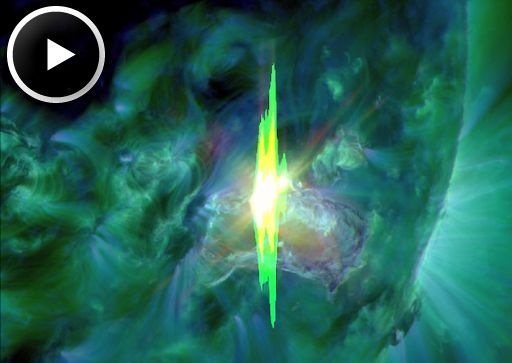
-2014 began with a bang. At 18:54 UT on January 1st, big sunspot AR1936 erupted, producing a strong M9-class solar flare. NASA's Solar Dynamics Observatory captured the explosion's extreme ultraviolet flash.
-The movie shows a dark filament of plasma racing away from the blast site, but most of the material fell back to the stellar surface. Nevertheless, the explosion did produce a CME that could deliver a glancing blow to Earth's magnetic field later this week. NOAA analysts are still evaluating this possibility.
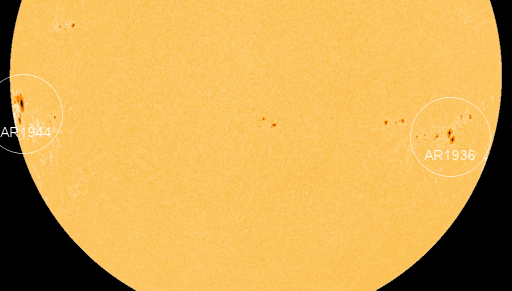
-The M9-flare of New Year's Day followed close on the heels of an M6-flare on New Year's Eve. Sunspot AR1936 produced both explosions. The New Year's Eve event produced a minor, slow-moving CME that is not expected to disturb Earth's magnetic field if and when it does arrive.
-Sunspot AR1936 is active, but new sunspot AR1944 looks even more potent. The behemoth active region emerged over the sun's southeastern limb on Jan 1st.
-Because of foreshortening near the sun's limb, the complexity of AR1944's magnetic field is still unknown. The sheer size of the sunspot, however, suggests it is capable of strong flares. The emergence of AR1944 combined with the ongoing activity from AR1936 has prompted NOAA forecasters to raise the odds of eruptions on Jan. 2nd to 70% for M-flares and 30% for X-flares.

 Astro Picture of the Day:
January 2, 2014
Source:
Astro Picture of the Day:
January 2, 2014
Source:
That's not the young crescent Moon poised above the western horizon at sunset. Instead it's Venus in a crescent phase, captured with a long telephoto lens from Quebec City, Canada, planet Earth on a chilly December 30th evening. The very bright celestial beacon is droping lower into the evening twilight every day. But it also grows larger in apparent size and becomes a steadily thinner crescent in binocular views as it heads toward an inferior conjunction, positioned between the Earth and the Sun on January 11. The next few evenings will see a young crescent Moon join the crescent Venus in the western twilight, though. Historically, the first observations of the phases of Venus were made by Galileo with his telescope in 1610, evidence consistent with the Copernican model of the Solar System, but not the Ptolemaic system.