 12-24-2013, 09:03 AM
|
#784
|
|
⊙▃⊙
  
Join Date: Nov 2007
Location: I live in the last place where you Look.
Age: 33
Posts: 7,376
|
 Re: Terry's Astronomy Thread.
What's in the sky tonight?
December 24, 2013
-The last-quarter Moon shines near Mars after they rise late tonight and into the Christmas-morning dawn.
-Big sunspot AR1928 is crackling with M-class solar flares. Magnetic fields spiraling away from the sunspot's location on the sun's western limb are well-connected to Earth, raising the possibility of a radiation storm around our planet if the flares intensify. NOAA forecasters estimate a 60% chance of M-class flares and a 10% chance of X-class flares on Dec. 23rd.
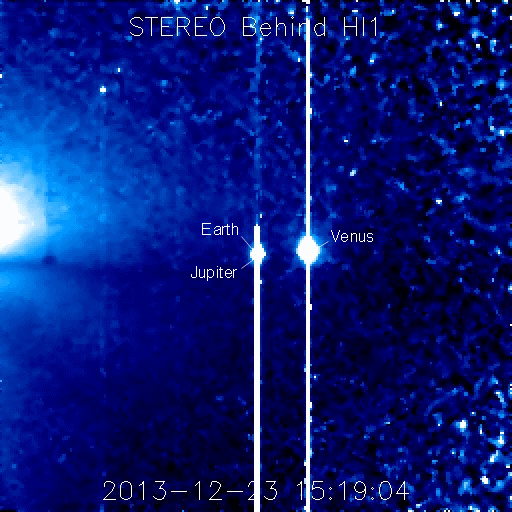
-According to some scholars, the Star of Bethlehem might have been a close encounter between Venus and Jupiter. The two brightest planets in the night sky, merged, would have made a spectacle of Biblical proportions. This Christmas, NASA's STEREO-B probe is observing something similar. Instead of Jupiter and Venus merging, however, the combined planets are Jupiter and Earth.
STEREO-B is located on the far side of the sun where it can look back and see Earth along with other planets in the Solar System. From STEREO-B's point of view, Earth and Jupiter are so close together that the spacecraft's Heliospheric Imager can barely tell the two apart. Venus is only 2 degrees from the Earth-Jupiter pair, so this is actually a 3-way conjunction.
This meeting is not nearly as tight as the putative Star of Bethlehem conjunction ~2000 years ago. At that time Venus and Jupiter could have been as little as 6 arcseconds (0.00166 degrees) apart. Nevertheless, the ongoing display is still special because it's the first "Christmas Star conjunction" from space. Happy Holidays from STEREO!
 Astro Picture of the Day:
December 24, 2013
Source:
Astro Picture of the Day:
December 24, 2013
Source:
Blown by fast winds from a hot, massive star, this cosmic bubble is huge. Cataloged as Sharpless 2-308 it lies some 5,200 light-years away toward the constellation of the Big Dog (Canis Major) and covers slightly more of the sky than a Full Moon. That corresponds to a diameter of 60 light-years at its estimated distance. The massive star that created the bubble, a Wolf-Rayet star, is the bright one near the center of the nebula. Wolf-Rayet stars have over 20 times the mass of the Sun and are thought to be in a brief, pre-supernova phase of massive star evolution. Fast winds from this Wolf-Rayet star create the bubble-shaped nebula as they sweep up slower moving material from an earlier phase of evolution. The windblown nebula has an age of about 70,000 years. Relatively faint emission captured in the expansive image is dominated by the glow of ionized oxygen atoms mapped to violet hues.
|

|

|