 12-12-2013, 08:01 AM
|
#8
|
|
⊙▃⊙
  
Join Date: Nov 2007
Location: I live in the last place where you Look.
Age: 33
Posts: 7,376
|
 Re: Terry's Astronomy Thread.
What's in the sky tonight?
December 12, 2013
-The tiny black shadow of Jupiter's fast-moving moon Io crosses Jupiter's face tonight from 10:02 p.m. EST to 12:17 a.m. EST. Following soon behind is Io itself, transiting from 10:37 p.m. to 12:52 a.m. EST. In a telescope, Io is much less visible on Jupiter's bright face than its shadow is.
-Earth is entering a stream of debris from rock comet 3200 Phaethon, source of the annual Geminid meteor shower. Forecasters expect the shower to peak on Dec. 13-14 with as many as 120 meteors per hour. Lunar interference will be a problem, as glare from the nearly-full Moon reduces the number of visible meteors 2- to 5-fold. You can listen to radar echoes from the Geminids, unaffected by moonlight, on Space Weather Radio. Also, tune into NASA's live web chat about the Geminids on Friday the 13th beginning at 11 pm EST found here: http://www.nasa.gov/connect/chat/gem...l#.UqbCkeIlhiI
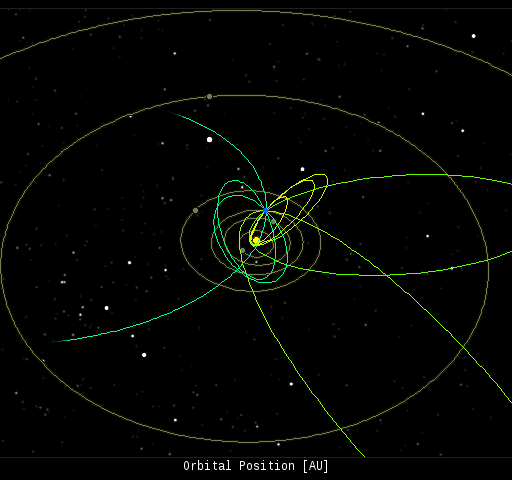
-Every night, a network of NASA all-sky cameras scans the skies above the United States for meteoritic fireballs. Automated software maintained by NASA's Meteoroid Environment Office calculates their orbits, velocity, penetration depth in Earth's atmosphere and many other characteristics. Daily results are presented on Spaceweather.com. On Dec. 11, 2013, the network reported 32 fireballs. (15 sporadics, 4 December Monocerotids, 9 Geminids, 4 sigma Hydrids)
 Astro Picture of the Day:
December 12, 2013
Source:
Astro Picture of the Day:
December 12, 2013
Source:
Alnitak, Alnilam, and Mintaka, are the bright bluish stars from east to west (lower right to upper left) along the diagonal in this gorgeous cosmic vista. Otherwise known as the Belt of Orion, these three blue supergiant stars are hotter and much more massive than the Sun. They lie about 1,500 light-years away, born of Orion's well-studied interstellar clouds. In fact, clouds of gas and dust adrift in this region have intriguing and some surprisingly familiar shapes, including the dark Horsehead Nebula and Flame Nebula near Alnitak at the lower right. The famous Orion Nebula itself is off the right edge of this colorful star field. The well-framed, wide-field telescopic image spans about 4 degrees on the sky.
|

|

|