What's in the sky tonight?
December 2, 2013
-Mars is passing 1.2° upper left of the 3.6-magnitude star Beta Virginis before dawn this morning and tomorrow morning — a sidelight from the Comet ISON hunt. Look for Mars shining very high in the southeast before dawn gets too bright.
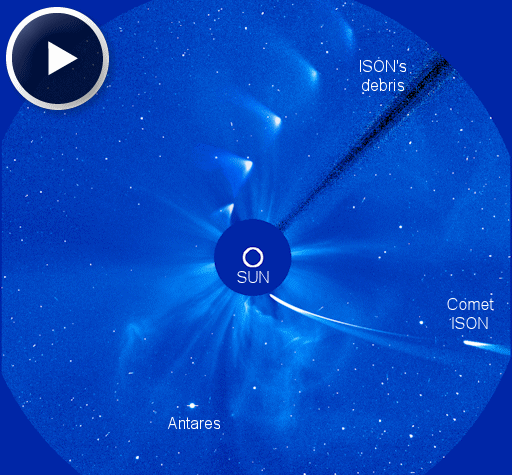
-Following its Thanksgiving Day brush with solar fire, sundiving Comet ISON is now just a cloud of dust. Among experts, a consensus is building that the comet broke apart shortly before perihelion (closest approach to the sun). In the movie, note how rapidly the comet fades just before it vanishes behind the occulting disk of the SOHO coronagraph.
-After perihelion, the comet emerges as a diffuse remnant of its former self. No one knows for sure what is inside that fan-shaped cloud. Possibilities include a small remnant nucleus or a "rubble pile" of furiously vaporizing fragments. By the end of the day on Nov. 28th, Comet ISON was spent.
As of Dec. 2nd, the cloud of debris is no brighter than a star of approximately 8th magnitude. Experienced astrophotographers might be able to capture the comet's fading "ghost" in the pre-dawn sky of early December, but a naked-eye spectacle is out of the question.
-China is about to join the club of nations that have landed on the Moon. On Dec. 1st, China's Chang'e-3 spacecraft blasted off from the Sichuan province in southwest China. It's payload: a six-wheeled, 260-lb rover named the "Jade Rabbit" ("Yutu" in Chinese), which could touch down on the lunar surface as early as Dec. 14th.
-Unlike the soft landings of unmanned spacecraft from the USA and the Soviet Union, Chang'e-3 will be able to survey the landscape first and determine the safest spot. The most likely destination is Sinus Iridum, the Bay of Rainbows.
A Chinese-made nuclear battery will power the rover after it lands on the lunar surface. Using plutonium-238, the battery will last for more than 30 years. The rover also has expandable solar arrays to absorb the sun’s energy during the day and retract at night to cover and protect equipment from temperatures of minus 170 degrees Celsius. Onboard sensors include a ground-probing radar, cameras, and a soil sampler.
Jade Rabbit's name comes a Chinese myth: According to the ancient story, a lady called Chang'e swallowed magic pills, which allowed her to fly to the Moon along with her pet rabbit "Yutu". There she became a goddess, and has been living on the Moon with the white rabbit ever since.

[img]
Astro Picture of the Day:
December 2, 2013
Source:
Comet Lovejoy was captured last week passing well in front of spiral galaxy M63. Discovered only three months ago and currently near its maximum brightness, Comet Lovejoy can be seen near the Big Dipper from dark northerly locations before dawn with the unaided eye. An unexpected rival to Comet ISON, C/2013 R1 (Lovejoy), pictured above, is currently sporting a large green coma and a beautifully textured ion tail. Comet Lovejoy is now headed back to the outer Solar System but should remain a good sight in binoculars for another few weeks. Conversely, spiral galaxy M63, lies far in the distance and is expected to remain stationary on the sky and hold its relative brightness for at least the next few million years.