What's in the sky tonight?
November 3, 2013
-Jupiter's moon Io casts its tiny shadow onto Jupiter tonight from 12:39 p.m. Eastern Daylight Time to 1:53 a.m. Eastern Standard Time. (A self-adjusting clock will make the switch at 2:00 a.m. your local daylight time.) Europa disappears into eclipse by Jupiter's shadow just west of the planet around 1:45 a.m. Eastern Daylight Time.
-New Moon (exact at 6:50 a.m. Eastern Standard Time).
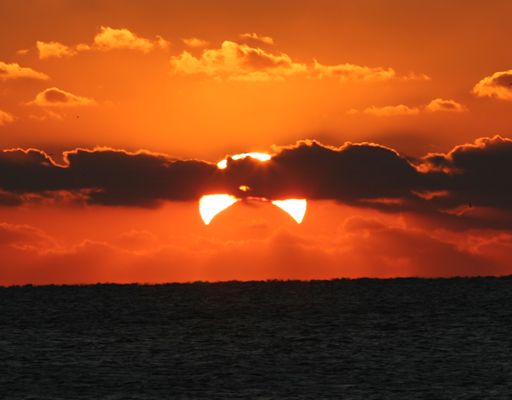
-This morning, the New Moon passed in front of the sun, producing a solar eclipse visible from the east Coast of North America to the western side of Africa. In Hampton, Virginia, the eclipse was underway when the morning sun rose over the Atlantic Ocean. "We had a beautiful view of the partially eclipsed sun peeking between the clouds," says photographer Stephen Gagnon who stationed his camera on Buckroe Beach.
-Later, the New Moon covered the entire sun, producing an annular eclipse and then a total solar eclipse visible across the Atlantic and Africa. The narrow path of totality touched several African nations including Gabon, the Congo, Uganda, Kenya, Ethiopia and Somalia.
 Astro Picture of the Day:
November 3, 2013
Source:
Astro Picture of the Day:
November 3, 2013
Source:
A spectacular geocentric celestial event of 2005 was a rare hybrid eclipse of the Sun - a total or an annular eclipse could be seen depending on the observer's location. For Fred Espenak, aboard a gently swaying ship within the middle of the Moon's shadow track about 2,200 kilometers west of the Galapagos, the eclipse was total, the lunar silhouette exactly covering the bright solar disk for a few brief moments. His camera captured a picture of totality revealing the extensive solar corona and prominences rising above the Sun's edge. But for Stephan Heinsius, near the end of the shadow track at Penonome Airfield, Panama, the Moon's apparent size had shrunk enough to create an annular eclipse, showing a complete annulus of the Sun's bright disk as a dramatic ring of fire. Pictures from the two locations are compared above. How rare is such a hybrid eclipse? Calculations show that during the 21st century just 3.1% (7 out of 224) of solar eclipses are hybrid while hybrids comprise about 5% of all solar eclipses over the period 2000 BC to AD 3000. Today's hybrid solar eclipse is most widely visible beyond the central shadow track as a brief partial eclipse from northeastern Americas through Africa, and along the track in an annular phase for only the first 15 seconds.
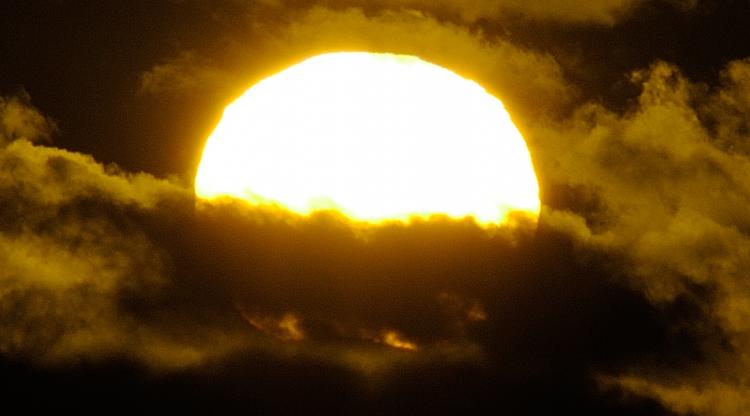
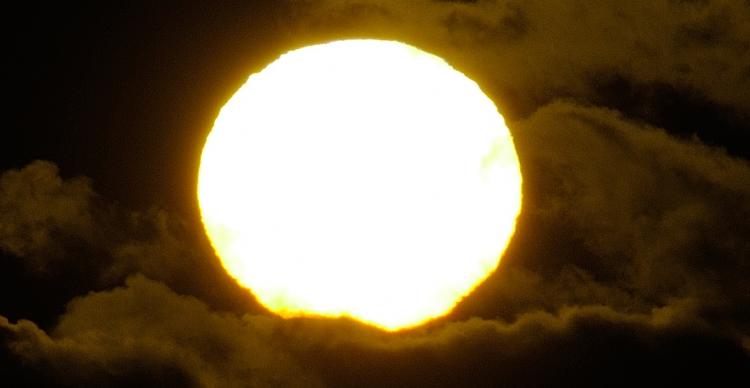
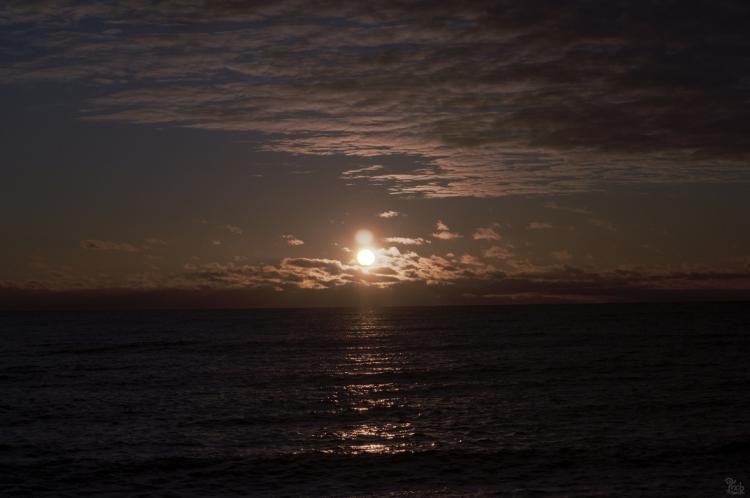
My own photos of the eclipse as seen from the shores of Toronto are below. Departing at 5am, passing through over half the city, and battling wind chills of -9 for a couple hours to find the best position resulted in the following photographs.