What's in the sky tonight?
October 7, 2013
-During twilight, the waxing crescent Moon shines to the right of Venus. Well to the Moon's lower right, while twilight is still fairly bright, binoculars show Saturn above Mercury.
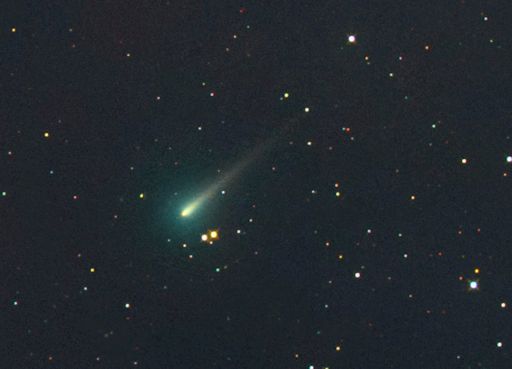
-Comet ISON is brightening as it approaches the sun. Estimates by experienced observers put the comet between 10th and 11th magnitude. That's too dim to see with the unaided eye, but bright enough for color photography through mid-sized backyard telescopes. Michael Jäger of Weißenkirchen, Austria, observed the comet on Oct. 5th and found that it was green. To image the comet, Jäger combined multiple exposures through red, green, blue, ultraviolet and infrared filters. Details may be found here.
ISON's green color comes from the gases surrounding its icy nucleus. Jets spewing from the comet's core probably contain cyanogen (CN: a poisonous gas found in many comets) and diatomic carbon (C2). Both substances glow green when illuminated by sunlight in the near-vacuum of space.
 Astro Picture of the Day:
October 7, 2013
Source:
Astro Picture of the Day:
October 7, 2013
Source:
The light spectra of the zodiacal light is the same as that of the sun. A part of the light absorbed by dust is re-emittted as infrared radiation. The zodiacal light is visible to the right of this picture, as a bright, triangular shaped entity. This photo was taken just after sunset in Nambia, June 2009 in the Southern Hemisphere. While the zodiacal light is often only found in the darkest of skies, it is often referred to as the "false dawn" due to its vast luminous expanse. The zodiacal light is the brightest typically around the time of the autumnal and vernal equinoxes. Credit & Copyright: Rudi Dobesberger (Sternfreunde Steyr).