What's in the sky tonight?
July 6, 2013
-Two hours after sunset, after darkness is truly complete, the east-northeast horizon bisects the Great Square of Pegasus across two of its opposite corners. By midnight the whole Great Square is up in good view, balancing on its bottom corner.
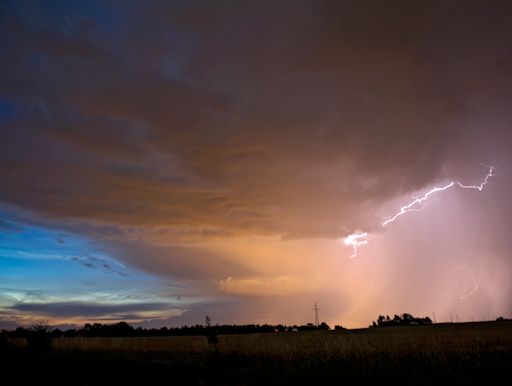
-Observers of noctilucent clouds often describe their appearance as "electric blue." The pale blue colors of the two phenomena are similar, but the resemblance is superficial. Lightning is hot, a genuinely electric discharge that heats the air to 30,000o C or more. The high temperature of the lightning's plasma (ionized air) gives it the same blue color as a hot O-type star. On the other hand, noctilucent clouds are cold, made of ice that crystallizes at the edge of space where the air temperature is -160o C. The tiny ice crystals in noctilucent clouds scatter blue light from the setting sun, which accounts for their lightning-like color. On July 3rd, Nature provided a color-check when a lightning storm erupted in Szubin, Poland, right in front of a noctilucent display. Marek Nikodem photographed the ensemble:
 Astro Picture of the Day:
July 6, 2013
Source:
Astro Picture of the Day:
July 6, 2013
Source:
The universe is filled with galaxies. But to see them astronomers must look out beyond the stars of our own galaxy, the Milky Way. This colorful Hubble Space Telescopic portrait features spiral galaxy NGC 6384, about 80 million light-years away in the direction of the constellation Ophiuchus. At that distance, NGC 6384 spans an estimated 150,000 light-years, while the Hubble close-up of the galaxy's central region is about 70,000 light-years wide. The sharp image shows details in the distant galaxy's blue star clusters and dust lanes along magnificent spiral arms, and a bright core dominated by yellowish starlight. Still, the individual stars seen in the picture are all in the relatively close foreground, well within our own galaxy. The brighter Milky Way stars show noticeable crosses, or diffraction spikes, caused by the telescope itself.