Thanks Reach, gold stinger, Winrar for the positive feedback! Reach, I have added the ISS video under the ISS tab because that's a great video and really gives perspective on what it's like to see the Earth from above.
If there's something you want to see added to the thread, post a suggestion! It might just start appearing in the main post.
What's in the sky tonight?
April 16, 2012
-As twilight fades, Look for bright Sirius in the southwest, Orion's horizontal Belt off to the right (with Betelgeuse above it, Rigel below it), and Aldebaran and Venus farther to the right in the west. As it sinks ever lower in the west, notice how it starts twinkling more violently, even temporarily changing colours to yellows and reds. Why is this? As it lowers into the horizon, Sirius and other stars have more atmosphere to travel to from your eyes to the location of the star. Because of this, the light of the star is often distorted through the increased atmosphere and can be strong enough to change what colour rays reach your eyes. This is the same reason why the Sun rises reddish in colour, and why the moon also rises in a red-orange colour. It also explains their often distorted and enlarged shape. Take this picture of the sun for example.
-Mercury (magnitude +0.4) is deep in the glow of sunrise. It's having a very poor dawn apparition just above the eastern horizon.
-Neptune (magnitude 7.9, in Aquarius) is barely emerging into view low in the east-southeast before dawn's first light. Both of these planets were hidden in the glare of the sun last week.
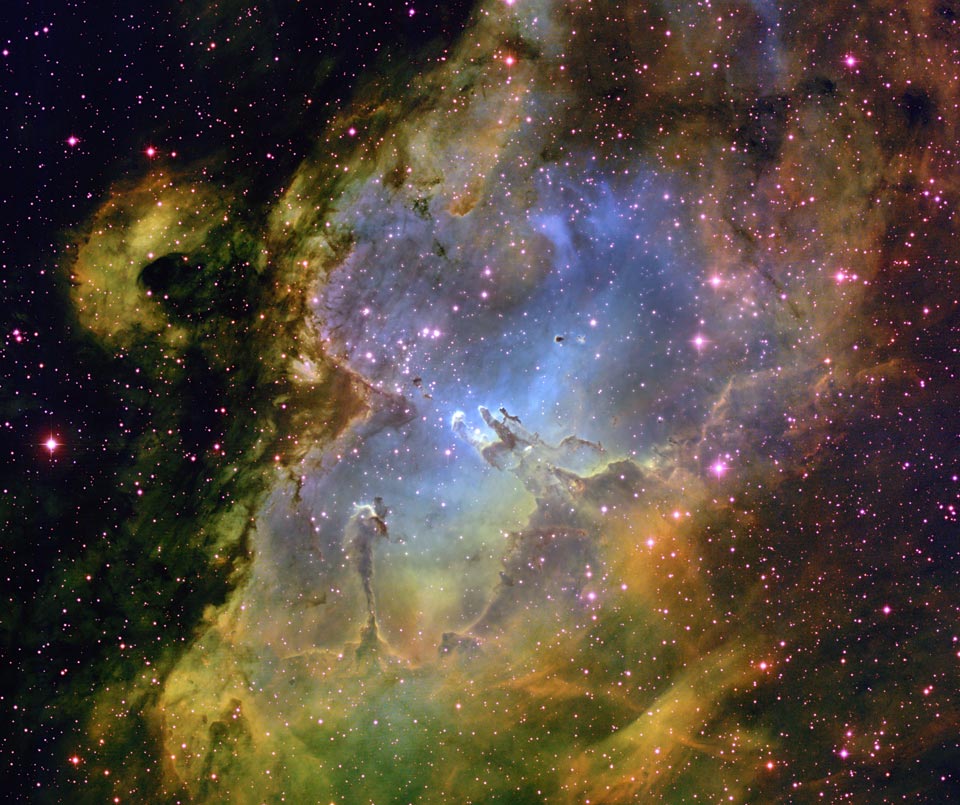 Source:
From afar, the whole thing looks like an Eagle. A closer look at the Eagle Nebula, however, shows the bright region is actually a window into the center of a larger dark shell of dust. Through this window, a brightly-lit workshop appears where a whole open cluster of stars is being formed. In this cavity tall pillars and round globules of dark dust and cold molecular gas remain where stars are still forming. Already visible are several young bright blue stars whose light and winds are burning away and pushing back the remaining filaments and walls of gas and dust. The Eagle emission nebula, tagged M16, lies about 6500 light years away, spans about 20 light-years, and is visible with binoculars toward the constellation of the Serpent (Serpens). This picture combines three specific emitted colors and was taken with the
0.9 meter telescope on Kitt Peak, Arizona, USA. The famous pillars are seen at the centre of this nebula.