What's in the sky tonight?
April 11, 2012
-With the Moon gone from the evening sky, it's deep-sky observing time again. Telescope users are familiar with the "Leo Trio" of galaxies (M65, M66, and NGC 3628) by the little chair asterism in the back leg of Leo. Can you detect M65 and M66 with binoculars?
-Toronto residents should consider the International Space Station Tracker as the Space Station makes very visible passes over the city tonight and an even brighter appearance tomorrow night at a reasonable hour. There will be two passes tonight:
Pass A:
This pass rises above the horizon at 20:20:54, and enters the shadow of the Earth at 20:30:09. The maximum altitude time is 20:25:52, and it will appear 26 degrees high at its peak. At it's peak it will appear in the Southeast.
Event Time Altitude Azimuth Distance (km)
Rises above horizon 20:20:54 -0° 209° (SSW) 2,283
Reaches 10° altitude 20:23:09 10° 196° (SSW) 1,435
Maximum altitude 20:25:52 26° 138° (SE ) 818
Enters shadow 20:30:09 3° 69° (ENE) 1,998
Drops below 10° altitude20:28:40 10° 78° (ENE) 1,446
Use the following star map to get a feel for the location and how fast the space station travels throughout it's ~6 minute appearance. More details can be found in the link in "Pass A".
 Pass B:
This is the better of the two passes tonight. At its peak, the space station will be almost 300 km closer to us, and the sun will also have long set. The maximum altitude will be 45 degrees - halfway up the sky.
Event Time Altitude Azimuth Distance (km)
Rises above horizon 21:56:46 0° 253° (WSW) 2,292
Reaches 10° altitude 21:58:52 10° 260° (W ) 1,442
Maximum altitude 22:02:00 45° 335° (NNW) 553
Enters shadow 22:02:37 39° 10° (N ) 615
Use the following star map to get a feel for the location and how fast the space station travels throughout it's ~6 minute appearance. More details can be found in the link in "Pass B".
 NOTE:
NOTE: These times are specifically calculated for TORONTO, ON. If you're interested and wish to have a shot at looking at the Space Station, open the "International Space Station Tracker" tab in this thread, and follow the instructions. Good luck, and don't blink!
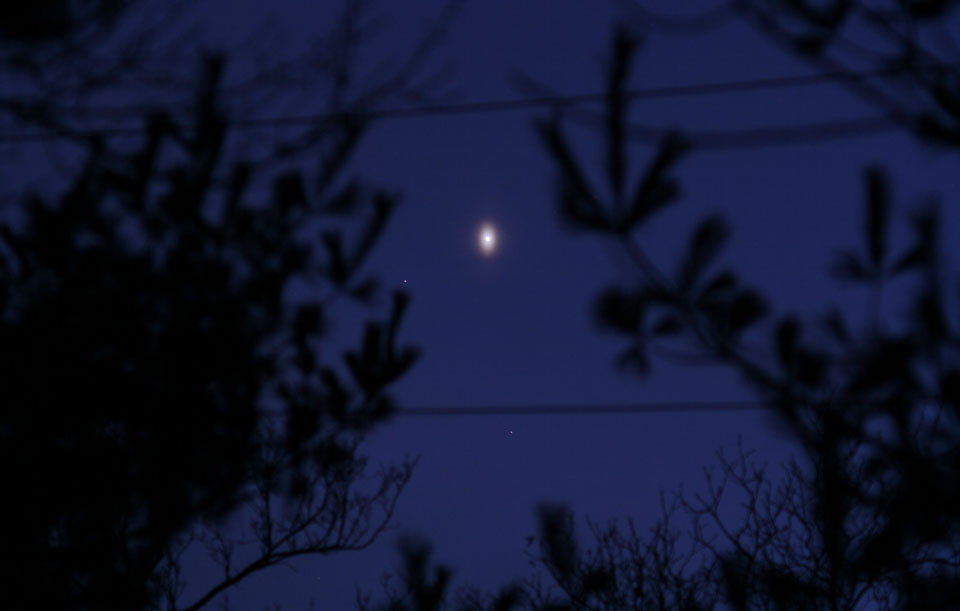 Source:
Why would Venus appear oval? Venus has been seen countless times from the surface of the Earth, and every time the Earth's atmosphere has dispersed its light to some degree. When the air has just the right amount of dust or water droplets, small but distant objects like Venus appear spread out into an angularly large aureole. Aureoles are not unusual to see and are frequently noted as circular coronas around the Sun or Moon. Recently, however, aureoles have been imaged that are not circular but distinctly oval. The above oval Venusian aureole was imaged by the astrophotographer who first noted the unusual phenomenon three years ago. Initially disputed, the unusual distortion has now been confirmed multiple times by several different astrophotographers. What causes the ellipticity is currently unknown, and although several hypotheses hold that horizontally oriented ice crystals are responsible, significant discussions about it are still taking place.