Quote:
Originally Posted by Myattboy

I've haven't attempted any kind of astrophotography yet, just live viewing so I'll have a good look at the camera you suggested when i get the time. Thank you.
Also, when i said "Do you think it'll be good for taking long exposures as well?" in my previous post, i was referring to the stability of the mount as i've read that a decent mount is required for astrophotography.
I'm new to both astronomy and photography so bear with me if i sound clueless lol.
|
Something to keep in mind is that the longer the exposure you take, the higher the need for a mount that will rotate with the Earth. When I take a photo, star trails are annoyingly long in as little an exposure as 15 seconds. Finding a telescope that has such a mount or a tripod that has such a mount would do wonders to you.
http://www.telescope.com/Mounts-Trip...e=SortByRating
http://www.telescope.com/Mounts-Trip...ByRating#tab-6
Here are a couple tripods that would help you shoot long exposure pictures. One of them is considerably more expensive than the other, but remember these are dollar values, so for your currency they might be a bit cheaper. Both of them appear to have very positive reviews, which is typically a good sign of a good product. Also for the more inexpensive one, take a look at some of the photos that people have taken with it as a mount!
What's in the sky tonight?
April 7, 2012
-The bright Moon rises around the end of twilight below Saturn and Spica in the east-southeast. Later in the evening the three shine higher: a long, narrow triangle with the Moon at the bottom.
-Saturn (magnitude +0.2, in Virgo) is at opposition April 15th. This week it rises almost around sunset and stands highest in the south around 1 or 2 a.m. daylight-saving time. Shining 5½° to Saturn's right is Spica: fainter, bluer, and twinklier.
-Keep careful watch on Saturn and its rings in a telescope. In the days leading up to opposition, watch for the Seeliger effect: a brightening of the rings with respect to the globe. This happens because the solid particles making up the rings backscatter sunlight (reflect it back in the direction it came from) more effectively than the planet's cloudtops do.
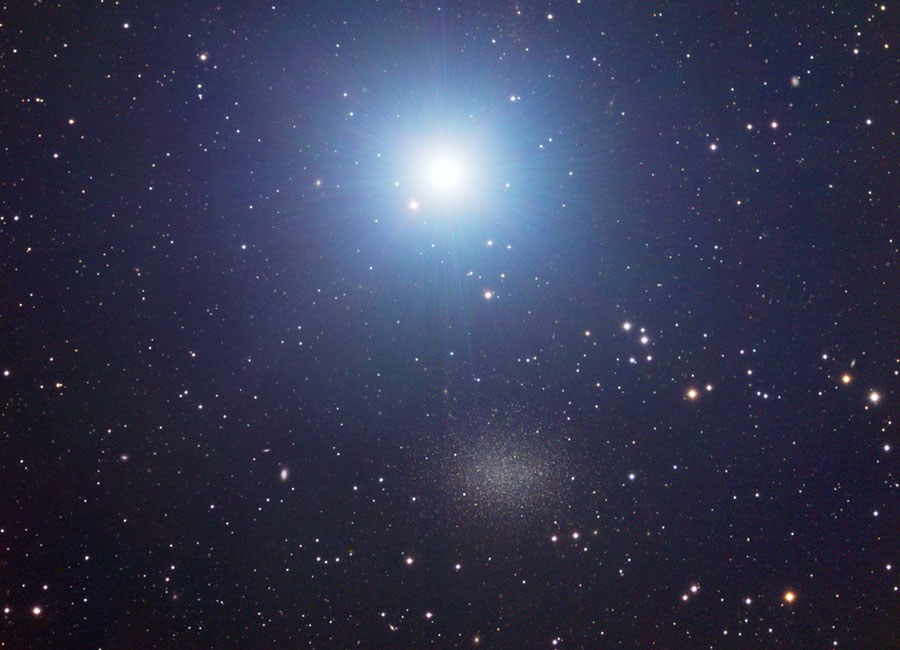
Astro Picture of the Day:
April 7, 2012
 Source:
The star near the top is so bright that it is sometimes hard to notice the galaxy toward the bottom. Pictured above, both the star, Regulus, and the galaxy, Leo I, can be found within one degree of each other toward the constellation of the Lion (Leo). Regulus is part of a multiple star system, with a close companion double star visible to the lower left of the young main sequence star. Leo I is a dwarf spheroidal galaxy in the Local Group of galaxies dominated by our Milky Way Galaxy and M31. Leo I is thought to be the most distant of the several known small satellite galaxies orbiting our Milky Way Galaxy. Regulus is located about 75 light years away, in contrast to Leo 1 which is located about 800,000 light years away. Regulus is easy to spot these days as it is accompanied by Mars after sunset and hangs around until the early morning hours.