Quote:
Originally Posted by Myattboy

Wow, every image is breathtaking. Thank you for sharing 
I'm getting into astronomy myself but unfortunately i live in one of the worst light polluted area's in the UK.
I've managed to get a few decent views of Jupiter, Saturn and the Moon but i'm really interested in viewing some DSOs. Currently saving my pennies for a telescope upgrade and trying to locate a dark site near where i live. |
Where abouts in the UK? I can pull up a light pollution map for the UK so you can see places that aren't as polluted that may or may not be nearby for the telescope you're after. Also, what kind of telescope are you looking for?
What's in the Sky Tonight?
April 3, 2012
-The Moon now forms the bottom point of a narrow triangle with Mars and Regulus, as shown below.
-Venus is the closest it will come to the middle of the Pleiades. This evening for the Americas, Venus is passing just ½° southeast of Alcyone (the brightest Pleiad) and ¼° south of the Atlas-Pleione pair. Venus is magnitude –4.5, which means Alcyone, at magnitude 2.85, is 900 times fainter!
-Saturn rises with Spica in Virgo late in the evening, clearly visible by midnight.

 Astro Picture of the Day:
April 3, 2012
Astro Picture of the Day:
April 3, 2012
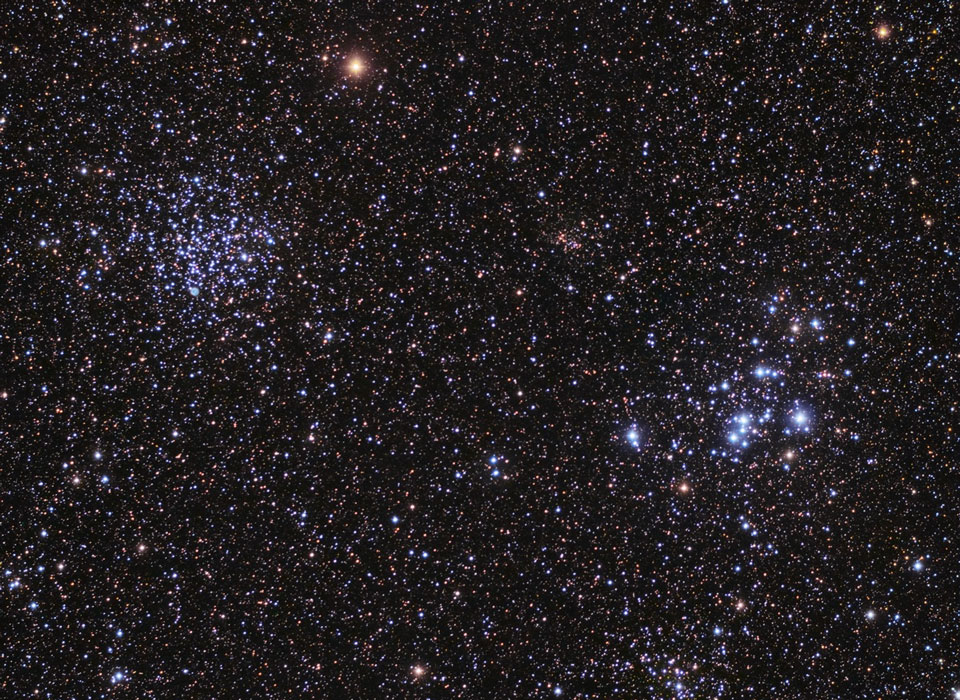 Source:
Many stars form in clusters. Galactic or open star clusters are relatively young swarms of bright stars born together near the plane of our Milky Way Galaxy. Separated by about a degree on the sky, two nice examples are M46 (upper left) 5,400 light-years in the distance and M47 (lower right) only 1,600 light-years away toward the nautical constellation Puppis. Around 300 million years young M46 contains a few hundred stars in a region about 30 light-years across. Aged 80 million years, M47 is a smaller but looser cluster of about 50 stars spanning 10 light-years. But this portrait of stellar youth also contains an ancient interloper. The small, colorful patch of glowing gas in M46 of the same colour is actually the planetary nebula NGC 2438 - the final phase in the life of a sun-like star billions of years old. It is found near the bottom of M46 within our line of sight to the cluster. NGC 2438 is estimated to be only 3,000 light-years distant and likely represents a foreground object, only by chance appearing along our line of sight to youthful M46.