It's great that this thread is encouraging people to learn more about astronomy, thanks Winrar and Gold Stinger for the feedback

Maybe I'll be able to teach you guys something before you enter your courses. In my high school, it was but a subchapter in grade 9 science but I found it to be the most interesting out of any science course I took.
What's in the Sky Tonight?
March 20, 2012
-This is the time of year when the dim Little Dipper juts to the right from Polaris (found in the constellation's its handle end) during evening hours. The much brighter Big Dipper curls over high above it, "dumping water" into it.
-This is also the time of year when Orion declines in the southwest after dark with his Belt roughly horizontal. But when does Orion's Belt appear exactly horizontal? That depends on where you're located east-west in your time zone, and on your latitude. How accurately can you time this event at your location? Orion's Belt is slightly curved, so judge by the two stars on its ends. Can you rig up a sighting reference to make your measurement more precise? Welcome to pre-telescopic astronomy!
Astro Picture of the Day
March 20, 2012
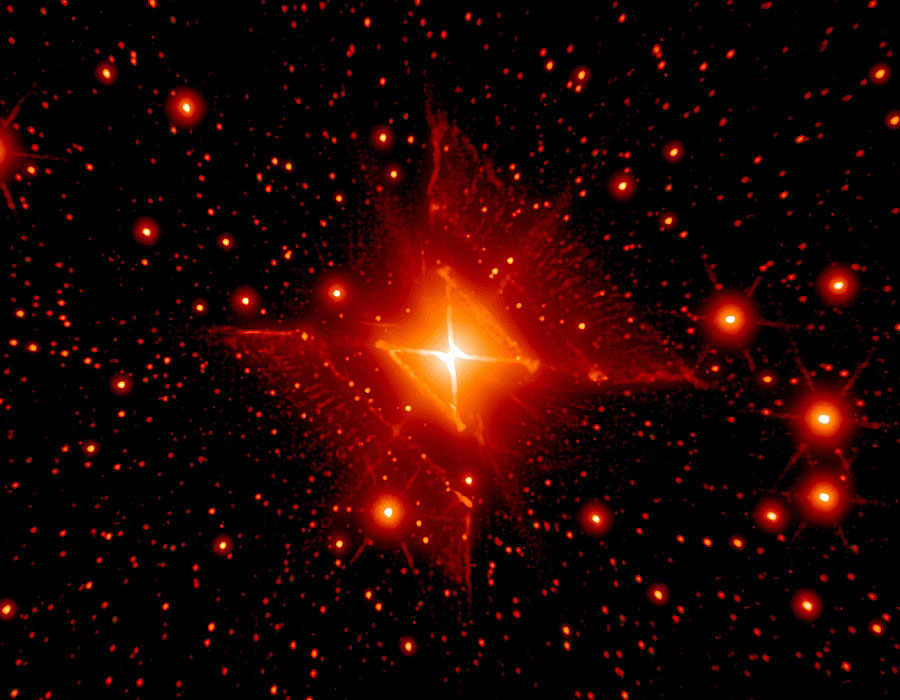 Source:
Does this look strange to you? Well it sure does to just about everyone who knows of it in the world of astronomy. This is MWC 922, nicknamed "The Red Square Nebula", found in the constellation Serpens. Only those relatively near the equator will be able to get a good view of this constellation, as the north and south hemispheres only ever see it near the horizon. What causes the nebula to be square? The answer to this one is that we don't know. It is thought that it only looks like a square through our spective. The star behind the nebula is a Be (very hot classification star, OBAFGKM being the hottest, M coldest) star that is losing mass in a bipolar outflow. It is spewing gas in a pair of conical outflows, This, combined with a ring of material that shields the rest of the projection, is the main theory on to how this square nebula exists.